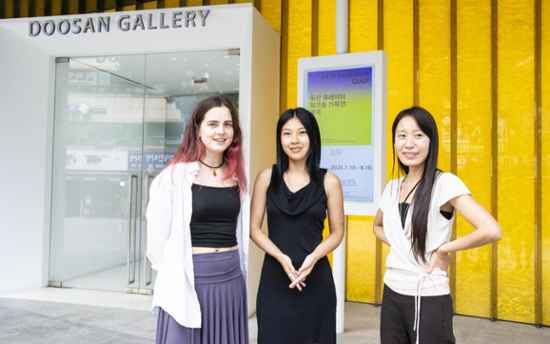

Elinor Haynes, from left, poses with Korean curators Lee Ji-eon and Rhii Sang-yeop at Doosan Art Center in downtown Seoul, July 11. Courtesy of Bereket Alemayehu
By Bereket Alemayehu
Doosan Art Center is exhibiting the works of Korean painter Lee Eun-sae and French visual artists Elinor Haynes and Laure Prouvost in downtown Seoul from July 7 to Aug. 8.
The exhibition, titled “Gulp,” is curated by three Korean co-curators who are part of the Curator Workshop, which discovers and supports young emerging curators with the potential to make fresh new contributions to the Korean contemporary art scene.
Lee Ji-eon, Rhii Sang-yeop and You Seung-a began the year-long curatorial program in 2023. They are the latest three young curators to go through the program, which has seen 39 participants since 2011.
However, this is the first time the gallery has exhibited foreign-made art curated by participants as a final result.
“Now we are trying to expand our variety,” You Jin-young, the lead curator at the center, told The Korea Times. “In Korea, there are many programs for artists, but there are none for curators. We want to support and promote emerging curators. That’s our biggest mission in this program. Usually, they take year-long seminars, workshops and do research together. After that, they co-curate the exhibition as a final result.”
“This is the first time for three curators to collaborate with one exhibition,” said Lee Ji-eon, one of the three co-curators. “We think it’s pretty resonant altogether, because each of us has a particular topic. We share many of our interests and points we are looking at. I think it’s pretty much well-harmonized.”
When asked how they selected the artists, Lee said they reviewed many potential local and international visual artists’ portfolios and then chose three, whose artworks are in alignment with their common topic.
The exhibit’s description states that its theme GULP, picked from Virginia Woolf’s novel “The Waves,” represents “the sound of connection between substance and body; the shape of an emotion or a desire, concealed or revealed; a metaphor for the experience of coveting that which is not our own. In this exhibition, the word ‘gulp’ is both language and image.”
Elinor Haynes, a London-based French artist, brought five of her sculptors for the first time to Korea. According to the exhibit’s description, she “uses sculpture to visually capture the intangible and malleable nature of the body.” Her sculptures “bear witness to the desire of the body, porous and permeable, to shatter the efficient grammar of machine-tech. Addressing the importance of fleshiness, embodiment, warmth and wetness, the artist imbues her work with liquid organic matter like bone marrow, saliva, sweat, and breast milk.”
“I think I like the tension between an object being quite beautiful and well made,” Haynes said. “I care about the technicality. And then I do twist it with something a bit gross or weird. I did a saliva fountain last year. But no one knew it was spit, people would just think it was a beautiful fountain. But they don’t know that it’s actually bodily liquid going around. I like to have the duality of something.”
Her newly presented work “Tu viens en moi, je viens en toi” (You come in me, I come in you) (2024) depicts the “intertwined relationship between the subject and the other, where their metaphorical ceramic bodies are entangled and penetrate each other, overlapped with a wooden trunk as an analogy.”

Artist Elinor Haynes introduces her art piece “You Come in Me, I Come in You,” made of ceramic, wax and a wooden trunk fetched from the Thames in London, on display at Doosan Art Center in downtown Seoul, July 11. Courtesy of Bereket Alemayehu
“Dry Spell” (2024) is “an assemblage of human and non-human figures approaching a drinking fountain to drink the water pooled inside it, showing the way different species, struggling with thirst, become one with the liquid itself, entangled. These works call out: We are alive, and so we are thirsty; we are alive, and so we are filthy.”
“I want to reveal the human body processes and things that we don’t want to see. Because we are bodily and fluid in many ways, we have a mark and an imprint on so many objects that we touch or that we feel. The ultra-hygienic culture wants to pretend like we don’t sweat and stink. I think we are perfectly well put together almost in sort of a post-human way that I’m interested in,” she said.
“In society, how to be more efficient, be more productive is important. how can you be the sleek machine that beats death, that’s maybe steam from a capitalist thought process, how can you be an efficient machine as a human? Only sleep this amount of time, do this, do that, Every time you’re not being a productive human, there’s things around it. I’m interested in the actual embodiment, the animal, the opposite of that, how we become fleshier, how we are disgusting, how we are leaking, how we spit, how we sweat, all these things that make us human. And the fact that we are not robots and we are not aluminum vessels, we carry so much, I think that’s reality.”
Laure Prouvost focuses on “becoming something else” in her two video works for the exhibition, “Shed a Light” (2018) and “Swallow” (2013).
“Swallow” stimulates a kind of sensory nostalgia. “Even as it visualizes the sound of strolling, gulping, conception, and sunlight as images, it points out the authority of the visual image, inviting us to listen to the sensation of tongue against palate, of inhalation and exhalation.”
And “Shed a Light” uses dynamic camera movements to “showcase a journey of escape from a melting, degraded planet to an alternate world. Follow Prouvost’s lead, and we eventually find ourselves before a fountain in the shape of a breast, invited to join in and get wet: You are the liquid inside this, I can feel it…I swallow you up. Here, the artist awakens, in us, the possibility of discovering the wilderness beyond our walls, of exploring anew that which has been abandoned.”
Lee Eun-sae’s paintings are visual and material performances of female desire. Lee captures “moments of thirst and desire, filth and disgust, licking, swallowing and vomiting.”
One scene in “Mite life 1, 4” (2023) derives from the artist’s own experience of quenching her thirst in the middle of the night with a bottle of water she doesn’t remember opening. The story references Wonhyo, a Buddhist monk and philosopher who quenched his thirst in a cave one night by drinking from what he thought was a gourd, only to find in the morning that it had been a human skull.
Meanwhile, Lee’s “The Mole with Sharp Teeth” (2016) series as well as “P cutter” (2016) “render the body in bolder lines and strokes, faceless and objectified within the structure of the male gaze while also returning that very gaze in turn.”
The Doosan Art Center was opened in 2007 under the Doosan Yonkang Foundation. The center discovers and fosters young artists deeply immersed in their practices in the fields of music, theater, dance and art, as well as offering various educational programs in arts, culture and the humanities. The center facilitates artist support programs, such as curator workshops, international residencies and art awards.
The exhibition gallery, located near Jongno 5ga Station on Seoul Metro Line 1, is open Tuesday to Saturday from 11 a.m. to 7 p.m. Visit doosanartcenter.com for more information.
Bereket Alemayehu is an Ethiopian photo artist, social activist and writer based in Seoul. He’s also co-founder of Hanokers, a refugee-led social initiative, and freelance contributor for Pressenza Press Agency.
Berita Korea Terbaru
berita terbaru artis korea
berita terbaru artis korea, berita terbaru korea, berita korea terbaru, berita artis korea terbaru, berita artis korea terbaru hari ini, berita selebriti korea terbaru, berita artis korea selatan terbaru, berita terbaru artis korea hari ini, berita terbaru korea utara vs amerika, berita terbaru konflik korea, berita terbaru artis korea selatan, berita artis terbaru korea, berita terbaru korea selatan, berita terbaru korea hari ini, berita terbaru hiburan korea
#Gulp #Doosans #Curator #Workshop #exhibition #features #artists #Korea #France