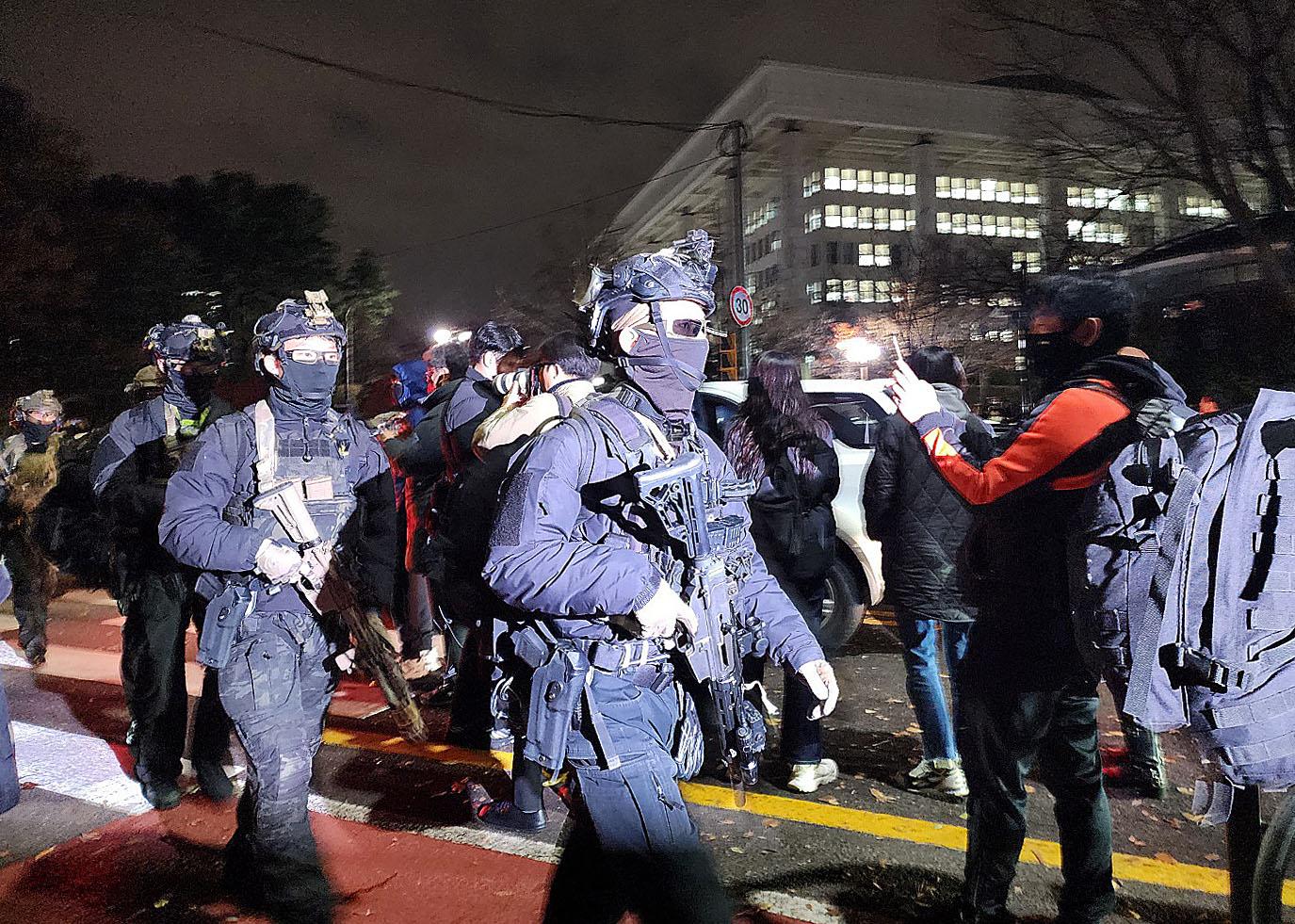

Military forces withdraw from the National Assembly in Seoul in the early morning of Dec. 4, 2024, after the National Assembly voted to lift the martial law decree imposed by then-President Yoon Suk Yeol. Korea Times photo by Ko Young-kwon
One year has passed since former President Yoon Suk Yeol declared martial law on Dec. 3, 2024, under the guise of rooting out “anti-state forces.”
After the shock declaration that eventually toppled the Yoon administration midway through his term and triggered an unexpected transfer of power, Korea’s political landscape has been dramatically reshaped, yet its chronic ailments have only deepened.
Yoon’s martial law fiasco resulted in the third impeachment of a president in Korean history, transferring power to a new government in the hands of the dominant Democratic Party of Korea (DPK), while the People Power Party (PPP), tainted by the “sin” of supporting Yoon’s insurrection attempt, remains adrift and incapable of acting as a credible opposition.
Only a handful of PPP lawmakers voiced opposition to Yoon’s martial law attempt from the beginning, as many others initially tried to defend or rationalize his actions. Fallout from the accountability debate has fractured the party, reducing it to what critics now describe as a mere observer, unable to fulfill even basic opposition duties. The DPK, meanwhile, is seeking to accelerate its ambitions, intensifying its condemnation of the attempted insurrection and using it to justify sweeping institutional reforms.
Political analysts interviewed by The Korea Times say the martial law episode pushed Korea’s already polarized politics into an even deeper state of confrontation and extremism, amplifying mistrust and aggravating hatred between the camps.

Then-President Yoon Suk Yeol delivers an emergency national address declaring martial law at the presidential office in Seoul, Dec. 3, 2024. Newsis
Myongji University professor Shin Yul noted that Yoon’s actions crossed a line that should never have been breached. By undermining the constitutional foundation of the rule of law, he said, the PPP not only lost its political footing, but enabled the DPK to begin drifting from institutional restraints.
“The gravest damage was that by declaring martial law, public trust in the rule of law and in democratic institutions nearly collapsed,” Shin said. “When martial law is declared, people start to believe that one can punish opponents and justify any action. Once that mindset takes hold and institutional trust erodes, the notion that anything is permissible becomes deeply ingrained. That is the most dangerous consequence.”
According to Shin, the erosion of institutional trust created a dangerous imbalance of power. With the PPP severely weakened, the DPK — already holding an overwhelming legislative majority — now faces little meaningful restraint. Yoon’s declaration shattered democratic safeguards, effectively granting the ruling party political free rein.
“‘You imposed martial law, so whatever we do is justified’ became the prevailing mindset,” Shin pointed out.
He further cautioned that the undermining of the rule of law has emboldened extreme proposals by the DPK, such as reducing judicial independence, weakening prosecutorial powers and even endorsing the surveillance of public officials under the justification of rooting out those involved in the martial law fiasco.
“These extreme ideas are emerging,” Shin warned, “because the foundation of constitutional democracy — rule of law — was shaken by martial law.”

Military forces withdraw from the road in front of the National Assembly in Seoul, Dec. 4, 2024, after the Assembly voted to lift then-President Yoon Suk Yeol’s martial law declaration. Korea Times photo by Park Simon
Park Sang-byoung, a professor at Inha University’s Graduate School of Policy Studies, highlighted another consequence of Yoon’s martial law move: the intensification of regionalism and political extremism. He characterized the relationship between the ruling and opposition parties as an “antagonistic symbiosis” — a dynamic in which mutual hostility paradoxically strengthens both sides as they jointly preserve their shared power structure.
“Both the ruling and opposition parties engage in attacks that ultimately strengthen, rather than weaken, their respective bases, which are deeply rooted in Korea’s political regionalism,” Park said. “It’s reminiscent of how North Korea’s Kim Il-sung and South Korea’s Park Chung-hee maintained their power: by appearing to fight publicly while reinforcing each other’s legitimacy.”
Park underscored that regionalism has only become further ingrained. The southeastern Gyeongsang region remains a conservative bastion for the PPP, reinforced by lingering support for Yoon’s actions, while the southwestern Jeolla region continues to back the DPK. This entrenched political geography, he said, not only predetermines electoral outcomes but also stifles political innovation.
“In Korea, elections are essentially fights between the Gyeongsang-based party and the Jeolla-based party,” he said. “As long as both parties secure fixed seats in their home regions, there is little incentive to reform. Political stagnation continues.”
![This photo, taken Sunday, shows a sign on one of the gates of the National Assembly in Seoul that reads: 'This is where the National Assembly speaker climbed over the wall to lift martial law [imposed by then-President Yoon Suk Yeol].' Speaker Woo Won-shik and several other lawmakers climbed the walls to enter the Assembly compound, which troops blocked the night martial law was declared. Yonhap](https://newsimg.ngopihangat.co.kr/2025/11/30/5fddd515-5dcd-4cee-90d4-eda27698e7b6.jpg?w=1200)
This photo, taken Sunday, shows a sign on one of the gates of the National Assembly in Seoul that reads: “This is where the National Assembly speaker climbed over the wall to lift martial law [imposed by then-President Yoon Suk Yeol].” Speaker Woo Won-shik and several other lawmakers climbed the walls to enter the Assembly compound, which troops blocked the night martial law was declared. Yonhap
Park stressed that only structural reforms, such as a redesign of the electoral system and constitutional revision, could break this cycle. But despite growing calls for a new constitutional order, political consensus remains elusive.
“Neither major party is willing to surrender its vested interests,” Park said. “The PPP, in particular, fears any reform that could undermine its control over candidate nominations. Its primary concern is securing safe seats in the Gyeongsang region, which is more populous than the DPK’s Jeolla stronghold, allowing the PPP to maintain its current stance.”
Berita Korea Terbaru
berita terbaru artis korea
Berita Olahraga
News
Berita Terkini
Berita Terbaru
Berita Teknologi
Seputar Teknologi
Drama Korea
Resep Masakan
Pendidikan
Berita Terbaru
Berita Terbaru
Berita Terbaru
berita terbaru artis korea, berita terbaru korea, berita korea terbaru, berita artis korea terbaru, berita artis korea terbaru hari ini, berita selebriti korea terbaru, berita artis korea selatan terbaru, berita terbaru artis korea hari ini, berita terbaru korea utara vs amerika, berita terbaru konflik korea, berita terbaru artis korea selatan, berita artis terbaru korea, berita terbaru korea selatan, berita terbaru korea hari ini, berita terbaru hiburan korea
#year #martial #law #Koreas #chronic #political #conflicts #deepened