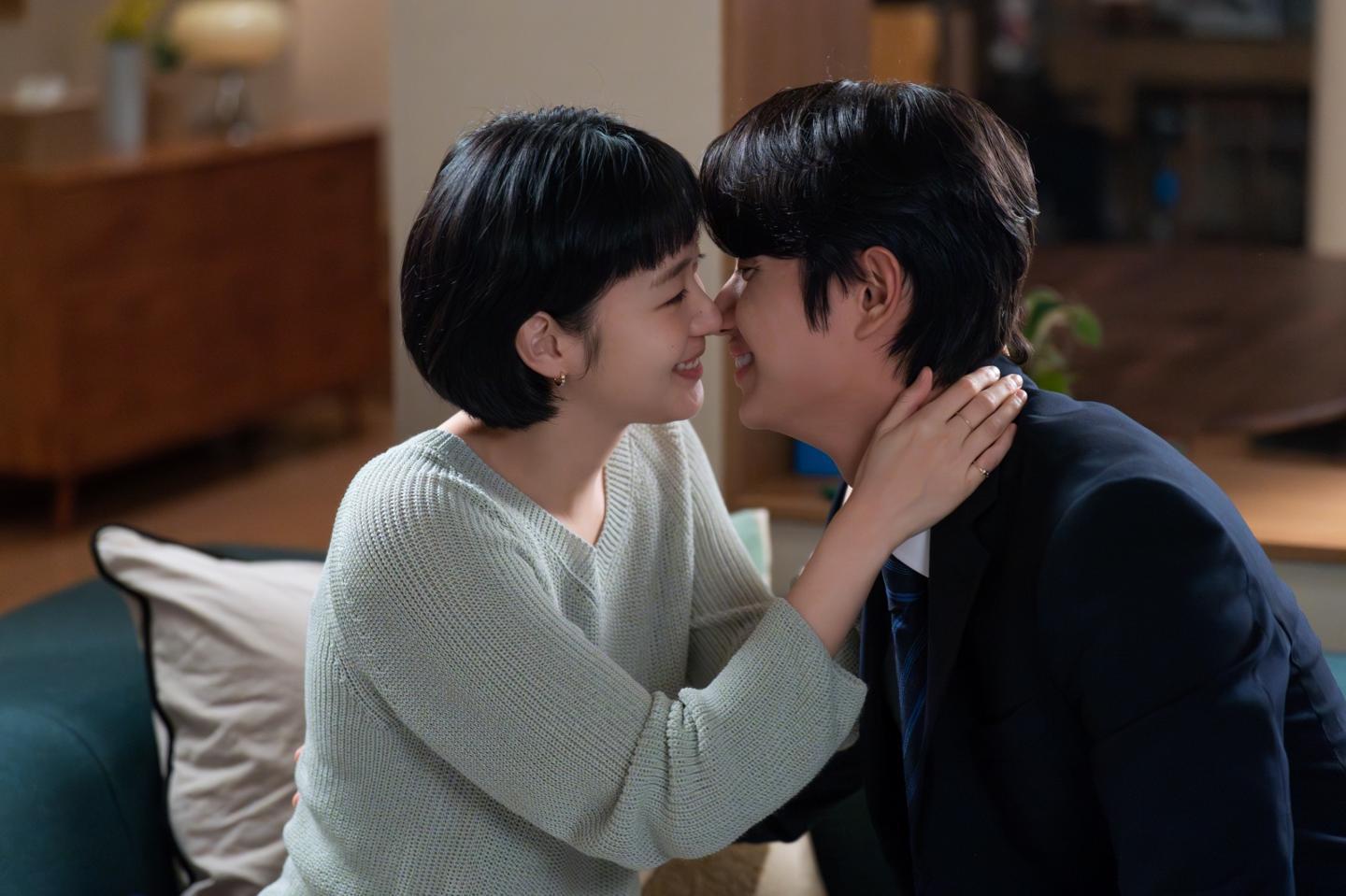
Yumi, left, played by Kim Go-eun, and Soon-rok, played by Kim Jae-won, appear in Season 3 of Tving original series “Yumi’s Cells.” Courtesy of Tving
“It is dry and tasteless. No matter what I see or experience, I don’t feel much excitement.”
Popular romance novelist Yumi (Kim Go-eun) finds dating tedious and trivial. As her days blur together without any sparks, the cells driving her joy, anger, sorrow and pleasure enter hibernation. Then, her publisher assigns her a new editor, Soon-rok (Kim Jae-won), and vitality returns to Yumi’s inner world of cells.
Soon-rok’s direct replies and blunt “truth bombs” first awaken her Swearing Cell, triggering a massive swarm of “angry snappers” — a rare, aggressive fish species that appears only when Yumi experiences deep anger. Once her annoyance and embarrassment transition into affection, her Love Cell reclaims its position as the powerful “Prime Cell.”
Tving drama series “Yumi’s Cells,” based on the popular webtoon, ended its run on May 5. While the first two seasons, which aired in 2021 and 2022, chronicled her romantic history and her leap from an ordinary office worker to a budding author, the third season returned after a four-year hiatus to capture Yumi’s journey as she encounters Soon-rok and rediscovers her forgotten self.
Yumi, played by Kim Go-eun, in Season 1 of “Yumi’s Cells” / Courtesy of Tving
Praised as a perfect multiseason series, the final season demonstrated its enduring appeal by ranking No. 1 among Tving’s weekly paid subscriber growth drives for four consecutive weeks.
Kim Goeun’s five-year journey as Yumi
“Yumi’s Cells” stands as the only Korean drama to trace a female protagonist’s growth across a long-term, multiseason format. Viewers built a deep connection with the character, empathizing with Yumi as if seeing a projection of their own lives or listening to a close friend. Kim Jae-won, who joined the cast as the male lead for this season, acknowledged the weight of that expectation.
“It felt like a precious daughter raised in a large family brought a new boyfriend home, and everyone folded their arms and asked, ‘Where were you, and what kind of kid are you?'” he said.
The series also captured a chapter in the life of Kim Go-eun. Mirroring Yumi’s rise as a popular writer, Kim firmly established herself as a reliable leading actor in her 30s. She anchored the drama with a grounded performance, delicately portraying universal emotions.
“From the first shoot, I was certain Yumi’s casting was done well,” said director Lee Sang-yup, who helmed all three seasons and oversaw the parallel growth of the character and the actress. “I am proud that I seem to have successfully documented a specific period of Kim’s life for a long time.”
Yumi, played by Kim Go-eun, in Season 2 of “Yumi’s Cells” / Courtesy of Tving
High-quality animation and perfect casting
The seamless integration of 3D animation with the live-action drama amplified the series’ appeal. The Love, Reason and Hunger cells thoroughly articulated Yumi’s emotions, helping viewers understand the character. The cells of the introverted Soon-rok functioned similarly. When he works in “low-power mode” outside, his Reason cell grinds away alone at a millstone. The rest of the village only awakens when he returns home.
Because the animation was produced first, Lee constantly communicated with the team to ensure it blended perfectly with the live-action filming.
“I tried to reproduce the images I liked in the original work exactly as they were, such as Soon-rok’s giant Lust Cell,” Lee said.
A scene from Season 3 of “Yumi’s Cells” / Courtesy of Tving
The male leads, praised for stepping straight out of the original webtoon, also drove the show’s popularity. From Ahn Bo-hyun’s Woong in Season 1 and Park Jin-young’s Babi in Season 2 to Kim’s Soon-rok in the final season, the men who loved, left and eventually married Yumi all perfectly embodied their drawn counterparts.
In his first leading role, Kim perfected the look with Soon-rok’s signature glasses and suit, dedicating himself to capturing the character’s calm, straightforward personality.
“I think it is a relief that I do not seem to have disappointed fans of the original Soon-rok,” he said.
Yumi, played by Kim Go-eun, in Season 3 of “Yumi’s Cells” / Courtesy of Tving
Lee, noting that he felt he had completed a major undertaking, offered a fond farewell to the protagonist.
“I got the feeling that Yumi became a good adult in Season 3,” he said. “I hope she lives well step by step, bravely and happily in the future too. I’m rooting for you, Yumi!”
This article from the Hankook Ilbo, the sister publication of The Korea Times, is translated by a generative AI system and edited by The Korea Times.
PakarPBN
A Private Blog Network (PBN) is a collection of websites that are controlled by a single individual or organization and used primarily to build backlinks to a “money site” in order to influence its ranking in search engines such as Google. The core idea behind a PBN is based on the importance of backlinks in Google’s ranking algorithm. Since Google views backlinks as signals of authority and trust, some website owners attempt to artificially create these signals through a controlled network of sites.
In a typical PBN setup, the owner acquires expired or aged domains that already have existing authority, backlinks, and history. These domains are rebuilt with new content and hosted separately, often using different IP addresses, hosting providers, themes, and ownership details to make them appear unrelated. Within the content published on these sites, links are strategically placed that point to the main website the owner wants to rank higher. By doing this, the owner attempts to pass link equity (also known as “link juice”) from the PBN sites to the target website.
The purpose of a PBN is to give the impression that the target website is naturally earning links from multiple independent sources. If done effectively, this can temporarily improve keyword rankings, increase organic visibility, and drive more traffic from search results.