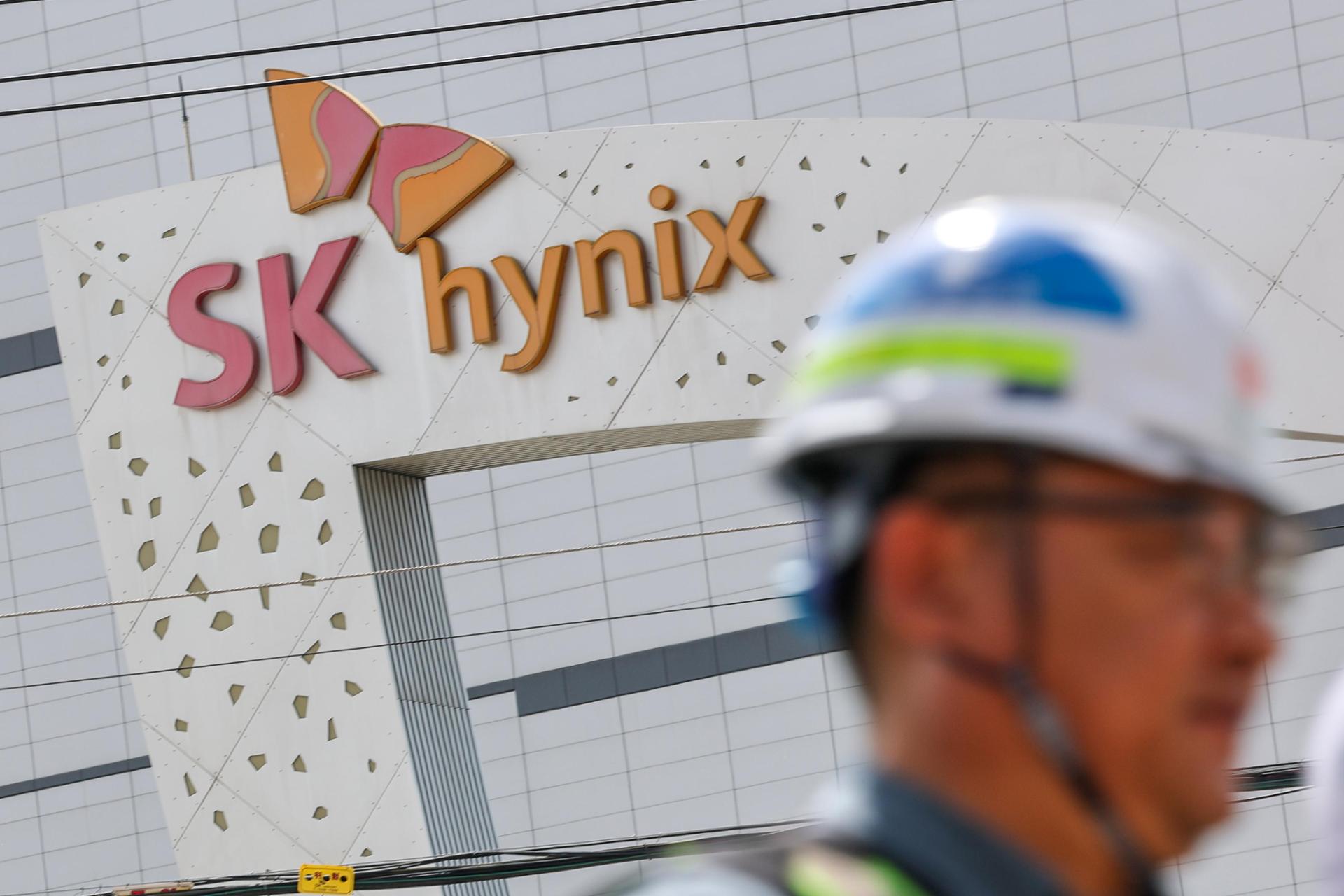
The SK hynix logo is seen behind a worker at its plant in Icheon, Gyeonggi Province, April 23. Yonhap
Korea’s debate over how to share the spoils of a historic semiconductor boom is intensifying, with the government claiming the need for a new mechanism to share unexpected gains from chipmakers — including tax revenues and excess profits — even as business and labor clash over how far the state should reach into corporate earnings.
Several top policymakers, including President Lee Jae Myung himself, have recently suggested a national-level — or even international — debate on how to use excess corporate gains, as part of efforts to narrow the pay gap between large and small firms.
At the International Labour Organization conference in Geneva last Wednesday, Labor Minister Kim Young-hoon said that gains from the chip boom driven by artificial intelligence (AI) demand should serve as many as possible.
“The benefits of AI should not be concentrated only in a few countries and companies, but should also translate into new opportunities for all nations and workers,” he said.
Those gains are the result of a semiconductor boom that has sent profits soaring at Samsung Electronics and SK hynix and is expected to generate tens of trillions of won in extra fiscal revenue this year and next. The government expects corporate tax payments from the two firms alone to reach around 125 trillion won ($82 billion) in 2027, at least 100 trillion won more than they paid last year.
The boom is already reshaping pay levels at the top of the industry. After protracted negotiations and under threat of a labor strike, Samsung agreed to a new bonus scheme under which employees in its memory chip division are estimated to receive up to 600 million won each this year.
Kim suggested sharing the excess gains as a form of “social solidarity wages,” inspired by Nordic models, and his ministry is planning to hold a public forum on the issue.
Last month, Kim Yong-beom, presidential chief of staff for policy, said in a social media post that “the fruits of the AI infrastructure era are not the achievement of any single company,” and called for designing a national dividend scheme to distribute excess tax revenue generated from the AI boom to all citizens.
Speaking at a press conference last week, President Lee also said that the issue “could have a very serious impact on our national industrial policy,” adding that it is likely to become “a global agenda item.”
In a recent interview with The Economist, the president said such a policy may require overhauling existing tax and redistribution systems, saying that using part of those excess profits to bolster consumers’ purchasing power through a form of basic income could be “one of the very useful policy options.”
Labor leaders say the question is no longer whether large companies’ windfall profits should be shared, but how.
“I think the question of how to share those excessive profits with the workers who generate them should be addressed through collective bargaining between labor and management, and extended to subcontracted workers as well,” Yang Kyung-soo, chief of the Korean Confederation of Trade Unions, said at last week’s press conference.
Members of Samsung Electronics labor unions hold a rally calling for bonus system reform near the company’s plant in Pyeongtaek, Gyeonggi Province, April 23. Korea Times photo by Shim Hyun-chul
Scholars such as Lee Jong-sun, director at the state-run Korea Labor and Employment Education Institute, share that view.
“The basic idea behind social solidarity wages is that the excess profits enjoyed by big firms are not the result of their efforts alone. They are built on the sweat and labor of workers of subcontractors further down the supply chain,” Lee said. “So instead of allowing the firms to keep all of the gains, our system should ensure that vendors and subcontractors also have enough room to raise wages to a reasonable level.”
Business groups, however, have bristled at the idea that the government — or even unions — should have a say in how those gains are carved up, with the Korea Enterprises Federation telling member companies that the distribution of corporate profits should not be a subject of collective bargaining.
Kim Gi-seung, an economics professor at Pusan National University, said any policy that effectively tells firms how much they must pay workers would clash with the basic principles of Korean business and labor laws.
“A third party cannot step in and decide that this firm’s workers should get this much and that firm’s workers should get that much. This is not possible under the current law,” he said.
Others stress that it is hard to define “excess” profits or even draw clear legal lines around subcontractors. They note that sectors like oil refining have also enjoyed huge windfalls in past commodity booms, arguing that industries simply take turns benefiting from global cycles, and that singling out semiconductors as uniquely “public” could be deemed an overreach.
Because of such concerns, even the government itself is divided over how far it can or should go, with competing ideas within the administration on how to use the unexpected gains.
Late last month, Finance Minister Koo Yun-cheol said the government plans to channel the excess tax revenue into a sovereign wealth fund, with detailed plans to be unveiled later this month. The Ministry of Planning and Budget is also seeking to create a new fund to capture such windfalls, with both ideas built on the principle of saving the money for future projects rather than using it up on short-term spending.
Ahn Jong-ki, professor at Korea University Institute for Research on Labor and Employment, said the semiconductor boom has opened “an entirely new phase” for the nation’s growth model, but warned that any new framework must be built to last.
Instead of trying to dictate how much companies should pay or simply ordering them to “hand over more money and let the state decide how to spend it,” he said that the priority should be to design incentives that make it naturally profitable for firms to act in the public interest. That means providing firms that raise subcontractor pay, for example, or share gains more broadly, with clear advantages in areas such as public procurement, regulation and tax.
“We need institutions that endure, not grand designs that can be reversed overnight,” Ahn said. “The government should keep market mechanisms functioning as they are and, using so-called ‘nudge-type’ approaches, create structures that naturally encourage labor and capital to pursue public values together. In such a framework, acting in the public interest would also help companies maximize their long-term gains, and that is the policy direction I hope the government will explore more seriously.”
PakarPBN
A Private Blog Network (PBN) is a collection of websites that are controlled by a single individual or organization and used primarily to build backlinks to a “money site” in order to influence its ranking in search engines such as Google. The core idea behind a PBN is based on the importance of backlinks in Google’s ranking algorithm. Since Google views backlinks as signals of authority and trust, some website owners attempt to artificially create these signals through a controlled network of sites.
In a typical PBN setup, the owner acquires expired or aged domains that already have existing authority, backlinks, and history. These domains are rebuilt with new content and hosted separately, often using different IP addresses, hosting providers, themes, and ownership details to make them appear unrelated. Within the content published on these sites, links are strategically placed that point to the main website the owner wants to rank higher. By doing this, the owner attempts to pass link equity (also known as “link juice”) from the PBN sites to the target website.
The purpose of a PBN is to give the impression that the target website is naturally earning links from multiple independent sources. If done effectively, this can temporarily improve keyword rankings, increase organic visibility, and drive more traffic from search results.