Members of the Geumcheon-gu branch of the Seoul Association of the Visually Impaired take part in a mudflat experience at Gungpyeong Fishing Village Experience and Recreation Village in Hwaseong, Gyeonggi Province. Korea Times photo by Lee Han-ho
“Even though I could not dig up many clams, the mudflat touched me and the mud touched me … those feelings were very good,” said Yang Hyung-keun, 66. “For people like us with visual impairments, touch is the most important of the five senses, and this was my first time touching a mudflat.”
Yang spoke in an excited voice after joining fellow members with visual impairments on a mudflat trip in May, which the government designated as a maritime tourism month. He said he travels with the group at least six or seven times a year, but this was his first visit to a mudflat.
For Yang, who has low vision, the soft mud — which even people with full vision can struggle to cross — had long felt impossible to enter. He loves the sea enough to name a sandy beach in Tongyeong, South Gyeongsang Province, as his favorite travel destination, but mudflats had remained a barrier.
Barrier-free travel made the trip possible. The Korea Tourism Organization (KTO)’s Gyeonggi-Incheon branch prepared the outing with an accessible travel operator. The Hankook Ilbo accompanied members of the Geumcheon-gu branch of the Seoul Association of the Visually Impaired on a sea trip around Gungpyeong Port in Hwaseong, Gyeonggi Province.
Travelers with visual impairments walk across a mudflat at Gungpyeong Fishing Village Experience and Recreation Village in Hwaseong, Gyeonggi Province. Korea Times photo by Lee Han-ho
Sea lovers experience first mudflat outing
The mudflat was the main stage of the trip, and the tide set the schedule. As the seawater pulled back toward the horizon, a chartered bus arrived with the day’s participants, many of them preparing for their first mudflat outing.
The KTO’s Gyeonggi-Incheon branch ran its first barrier-free maritime travel program in May 2025 at Gaetgol Eco Park in Siheung, Gyeonggi Province, as part of the same campaign. After positive feedback, the organization expanded the program this year to six sessions across Incheon, Siheung, Ansan and Hwaseong.
The program has also broadened. Last year’s offerings featured salt flat visits, while this year’s sessions include mudflat outings, sea cable car rides and ecological wetland tours.
Each session caters to different participants, including tailored programs for people with physical mobility limits and those who are deaf or hard of hearing. The session the Hankook Ilbo accompanied featured a mudflat outing for people who are legally blind or have low vision.
Travelers with visual impairments gather shellfish at Gungpyeong Fishing Village Experience and Recreation Village in Hwaseong, Gyeonggi Province. Korea Times photo by Lee Han-ho
After a short safety briefing, participants put on boots and prepared to enter the mudflat. Some hesitated. A guide with the accessible travel program said, “If you do not feel comfortable, you do not have to force yourself to go down.”
Instead, the guide suggested a wooden deck path crossing the mudflat and a stone path along the edge. The first step in enjoying travel, the approach suggested, was to experience something new without being pushed beyond one’s comfort level.
Others, eager for the new experience, had already moved farther onto the mudflat, staying close to companions who served as their guides.
Their reason for seeking out the sea, even without being able to see it, lies in touch. Popular culture often portrays blind people as having especially sharp hearing, but touch can matter just as much, and sometimes more.
Members of the Geumcheon-gu branch of the Seoul Association of the Visually Impaired take part in a mudflat experience at Gungpyeong Fishing Village Experience and Recreation Village in Hwaseong, Gyeonggi Province. Korea Times photo by Lee Han-ho
Yang lightly placed his hand on the reporter’s arm and said, “When we meet one another, we first hold hands.”
“Like that, I wanted to experience the sea and the mudflat through feeling, or touch,” he said. “I came on today’s trip because I wanted to touch the mud and feel it on my hands and feet.” Yang said he once lost track of time walking barefoot on a fine sandy beach during a trip to Tongyeong with fellow branch members.
A traveler with a visual impairment feels the bark of a pine tree during a walk along the Gungpyeong coastal trail in Hwaseong, Gyeonggi Province. Korea Times photo by Lee Han-ho
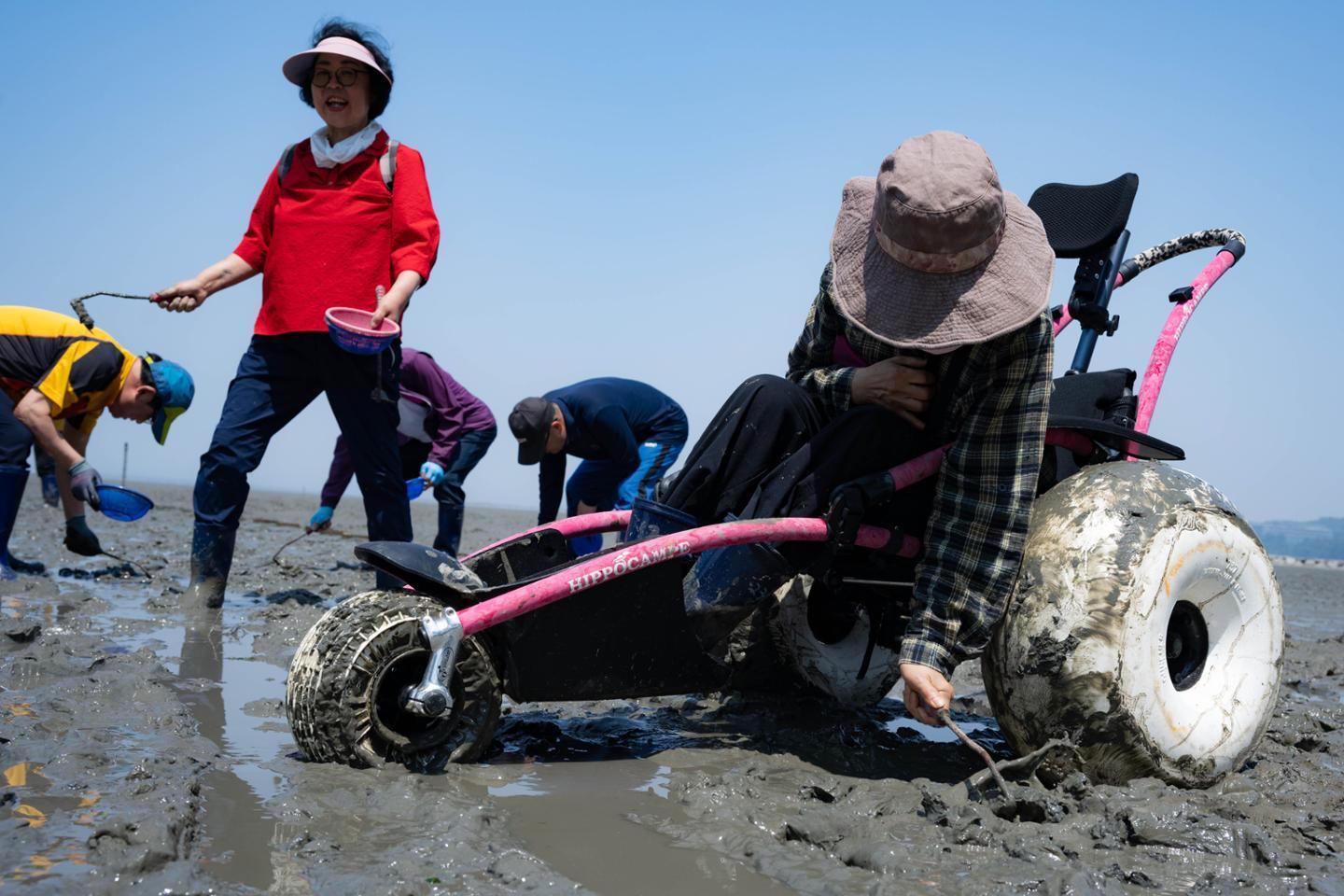
As participants walked across the tidal flat, a professional guide brought out a specialized wheelchair designed to move across mud, sand and water. For people with mobility limitations, this equipment is the difference between watching from the shore and taking part.
The device, the Hippocampe, is manufactured by the French company Vipamat. Its large, buoy-like wheels keep it from sinking and help it move smoothly over the terrain. Its low frame lets users bend down to gather seafood at low tide. With the wheels swapped, it can also serve as a swimming aid.
Most participants that day did not have major physical mobility difficulties, but they took turns trying the wheelchair.
A tourist in a specialized Hippocampe wheelchair gathers shellfish at Gungpyeong Fishing Village Experience and Recreation Village in Hwaseong, Gyeonggi Province. Korea Times photo by Lee Han-ho
After feeling the mudflat, gathering seafood at low tide and trying the wheelchair, it was time to leave the mud. Two more accessible sites remained on the day’s itinerary.
“Some hesitated at first because they were scared, but others said they enjoyed the trip,” Yang said. “If there is another opportunity next time, I hope everyone will experience it together more actively.”
A participant in a mudflat experience program tries a specialized Hippocampe wheelchair at Gungpyeong Fishing Village Experience and Recreation Village in Hwaseong, Gyeonggi Province. Korea Times photo by Lee Han-ho
Expanding accessible nature tourism
The Ministry of Culture, Sports and Tourism and the KTO have designated barrier-free tourism sites since 2015. The program supports people with disabilities, older adults, pregnant women and families traveling with infants. The number of accessible sites has grown from six in the first year to 212 this year.
One example is King Canoe on Uiam Lake in Chuncheon, Gangwon Province, which makes water recreation more accessible. The large canoe can carry up to 12 people and is modified for users of manual and electric wheelchairs. The site features four accessible canoes, allowing wheelchair users to join the activity instead of waiting on the dock. Nearby Samaksan Lake Cable Car can also be linked with the trip.
Members of the Geumcheon-gu branch of the Seoul Association of the Visually Impaired walk along a wooden deck path on a Gungpyeong coastal trail in Hwaseong, Gyeonggi Province. Korea Times photo by Lee Han-ho
Seo Young-min, a team leader at Moving Trip who guided the Gungpyeong Port outing, emphasized the importance of diverse offerings.
“I think people with disabilities and those without disabilities have the same desire for experiences,” Seo said. “Because of that, I hope barrier-free travel will not be limited to indoor exhibits, but will prepare many kinds of hands-on experiences that explore outdoor tourist sites.”
“Most people with disabilities in our country were not born with disabilities but acquired them later in life. Just as anyone grows older, I hope barrier-free travel will become a natural experience, with the mindset that anyone can experience disability,” Seo added.
Members of the Geumcheon-gu branch of the Seoul Association of the Visually Impaired participate in a guided tour at Maehyang-ri Peace Eco Park in Hwaseong, Gyeonggi Province. Korea Times photo by Lee Han-ho
The government sees the expansion of barrier-free tourism sites not only as a welfare policy but also as an economic strategy, as older populations and the number of people with disabilities grow worldwide.
The culture ministry estimated Korea’s domestic barrier-free tourism market at 6.6 trillion won ($4.37 billion) as of 2024, with potential demand worth about 11 trillion won.
This article from the Hankook Ilbo, the sister publication of The Korea Times, is translated by a generative AI system and edited by The Korea Times.
PakarPBN
A Private Blog Network (PBN) is a collection of websites that are controlled by a single individual or organization and used primarily to build backlinks to a “money site” in order to influence its ranking in search engines such as Google. The core idea behind a PBN is based on the importance of backlinks in Google’s ranking algorithm. Since Google views backlinks as signals of authority and trust, some website owners attempt to artificially create these signals through a controlled network of sites.
In a typical PBN setup, the owner acquires expired or aged domains that already have existing authority, backlinks, and history. These domains are rebuilt with new content and hosted separately, often using different IP addresses, hosting providers, themes, and ownership details to make them appear unrelated. Within the content published on these sites, links are strategically placed that point to the main website the owner wants to rank higher. By doing this, the owner attempts to pass link equity (also known as “link juice”) from the PBN sites to the target website.
The purpose of a PBN is to give the impression that the target website is naturally earning links from multiple independent sources. If done effectively, this can temporarily improve keyword rankings, increase organic visibility, and drive more traffic from search results.