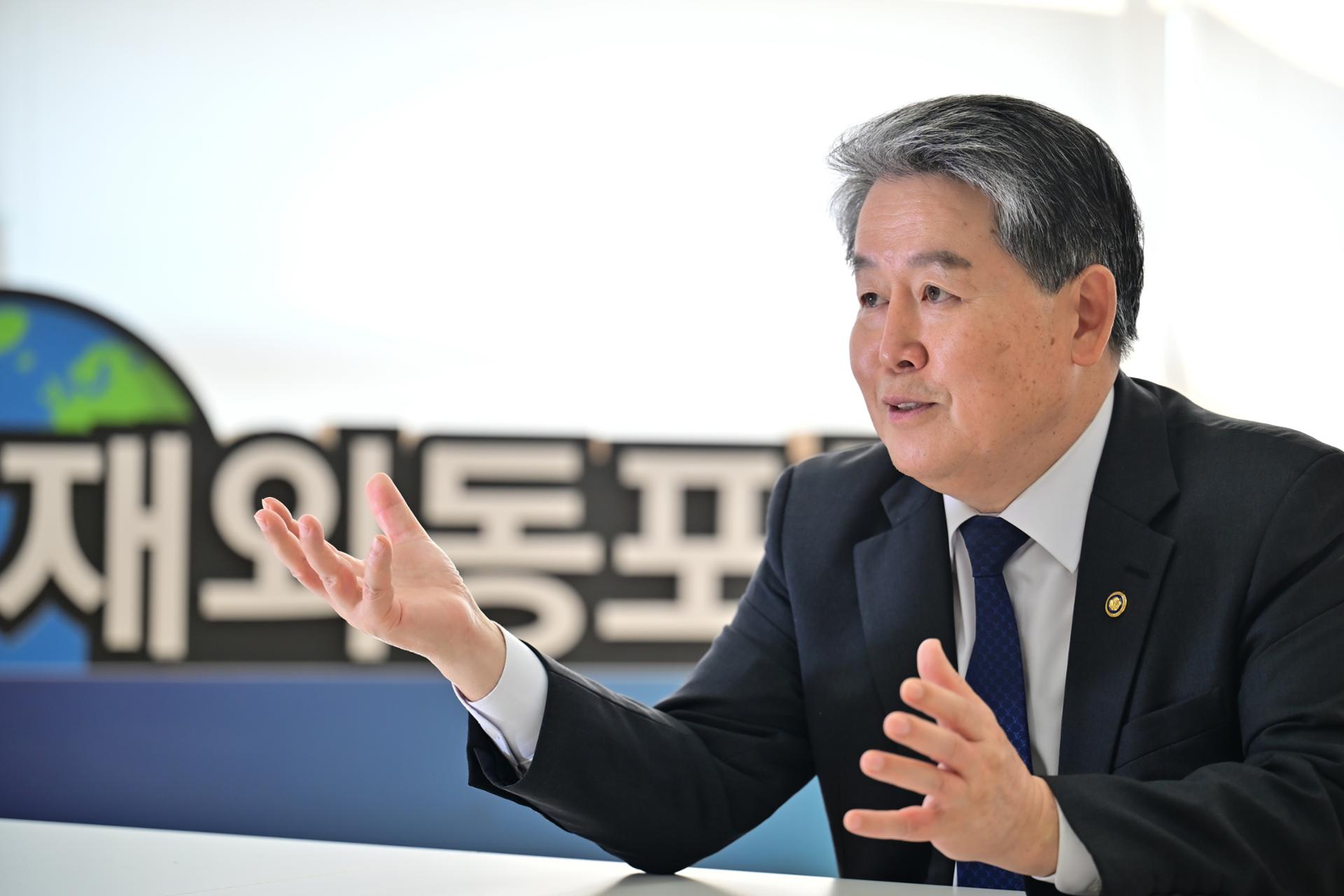
Kim Kyung-hyup, commissioner of the Overseas Koreans Agency (OKA), speaks during an interview with The Korea Times at OKA’s Service and Support Center for Overseas Koreans in Seoul, Tuesday. Korea Times photo by Choi Won-suk
Once a primary source of emigrants and adoptees due to historical instability, Korea has transformed into one of the most favorable destinations for global migration over the past decades, fueled by robust economic growth and cultural influence.
The overseas Korean population — those of Korean descent or citizenship living abroad — have been steadily growing, reaching about 7 million as of 2025. Of that total, about 4.6 million, or 66 percent, hold foreign citizenship, while the remaining 2.4 million retain Korean nationality.
At the same time, the number of overseas Koreans returning to Korea — including those with stateless status — continues to climb, now accounting for more than 30 percent of the foreign national population in the country.
This represents a shift from departure to homecoming. However, managing the complex legal and social issues surrounding the overseas Korean community remains a formidable challenge for the government, ranging from visa administration to sociocultural integration.
Kim Kyung-hyup, commissioner of the Overseas Koreans Agency (OKA) under the Ministry of Foreign Affairs, wants to meet that challenge head-on. The former three-term lawmaker, who took office in September 2025, sat down with The Korea Times on May 12 — ahead of the agency’s third anniversary on June 5 — to outline his vision for a more inclusive policy framework.
He said Korea needs to be more inclusive in embracing returning Koreans administratively and lawfully, while strengthening support for those residing abroad. He believes that providing such support is not only a fundamental right of overseas Koreans but also a strategic asset for Korea’s long-term growth.
“While there is ongoing debate about opening our borders to general immigration to address the demographic cliff, the reality requires careful consideration of many factors. In contrast, overseas Koreans offer a much smoother path to social integration due to their cultural and emotional ties with Korea,” Kim said.
“Therefore, our primary goal is to implement an inclusive, nondiscriminatory overseas Korean policy that prioritizes the embrace of them as a first step.”
Dual citizenship as demographic tool
Central to Kim’s agenda is a push to lower the age threshold for dual citizenship, a move he frames as both an economic and demographic imperative.
Under the current law, dual nationality is permitted primarily for those aged 65 and older or in limited special categories. Kim argued that extending eligibility to working-age Koreans abroad would help address the country’s population decline while securing new growth engines.
“Lowering the age threshold for dual citizenship would be beneficial to our national economy. Other nations are already actively leveraging the capabilities of their diasporas by operating programs like India’s OCI,” he said, referring to India’s Overseas Citizenship of India system.
“Considering this global trend of utilizing the diaspora as a driver for economic growth, Korea should reconsider its stance on dual citizenship.”
Participants take a group photo during the 2025 Overseas Korean Adoptees Gathering hosted by the Overseas Koreans Agency (OKA) on Nov. 14, 2025. Courtesy of OKA
Adoptee rights improvement
One immediate test of that inclusive vision begins Monday with the annual Overseas Korean Adoptees Gathering, running through May 22. The event offers cultural programs and official fact-finding opportunities for adoptees seeking to trace their roots.
“This year’s gathering carries particular weight as it brings together established leaders of adoptee organizations with those visiting their homeland for the first time … Notably, this event will involve the National Center for the Rights of the Child and the Truth and Reconciliation Commission to address and investigate historical allegations of human rights violations during the adoption process, meaning those adoptees can have a window of resolving long-standing issues,” Kim explained.
“There have been numerous allegations regarding human trafficking and illegal adoptions in the past … Alongside the general programs, the event will facilitate fact-finding and evidence-gathering for cases that have already been reported to the Truth and Reconciliation Commission.”
He described the gathering as a chance for adoptees to connect with their homeland on a deeper level and to feel that they are not alone, even if they do not physically live in Korea.
“I want them to go home knowing that they have a steadfast pillar of support behind them: their homeland.”
This image shows the list of countries supported by a new identity verification system, enabling overseas Koreans without Korean phone numbers to access government digital services. Captured from OKA’s website
Overseas voting reform
Kim also turned his attention to the barriers facing overseas voters. Currently, Koreans living overseas can vote in presidential elections and for proportional representation seats in parliamentary elections. However, due to the limited number of embassies or consulates where registered voters can cast ballots, some must travel for more than a day to reach a polling station and their stories have made headlines.
“That shouldn’t be a touching news story — it should be criticized,” Kim said. “Under the current system, it is impossible for our overseas citizens to have a high voter turnout. We have made voting far too difficult for them.”
Kim argued that online and mail-in voting should be guaranteed as a constitutional right.
“We need to implement mail-in ballots and electronic voting to ensure their voices are heard,” he said, urging the National Assembly to pass the necessary legislation this year so the new system can be in place for the next general election in 2028.
On a related front, the agency recently launched a new identity verification system that supports foreign mobile numbers, allowing overseas Koreans to access government digital services even without Korean mobile numbers. Kim acknowledged the update removes a long-standing hurdle but said much work remains to modernize the broader government system.
Kim Kyung-hyup, center, commissioner of the Overseas Korean Agency, poses with Koryoin, or ethnic Koreans from from Russia and Central Asian countries, in Gwangju, Feb. 11. Courtesy of OKA
Building diaspora network
Kim emphasized the need for the government to provide enhanced networking and institutional support for Koreans abroad through a dedicated online community and a centralized database.
He believes that the current lack of empirical data makes it difficult to persuade relevant government agencies to adopt overseas Korean policies. Establishing a comprehensive database, Kim said, can enable the government to move beyond abstract ideas and develop practical and tangible policy initiatives based on concrete ground.
“Overseas Koreans are already expanding Korea’s ‘economic frontiers’ through the global success of K-food and hallyu, or the Korean wave. If we can effectively organize these communities — much like the Jewish diaspora in the United States — we can build a formidable capacity for public diplomacy,” he said, pointing to its broader geopolitical potential, from advocating for the rights of Korean residents abroad to influencing peace and security issues on the Korean Peninsula.
“We must maximize the capabilities of Koreans abroad.”
As the agency marks its third year, Kim hopes to lay the groundwork for private foundations that serve as a bridge between Korea and its diaspora, citing organizations such as the Jewish Agency for Israel and Japan’s Nippon Foundation as examples.
“As a newly established agency, we are at a critical juncture where our administrative and support frameworks must be overhauled,” he said. “To ensure comprehensive support to overseas Koreans, we need a dual-track system: government support alongside private institutions.”
PakarPBN
A Private Blog Network (PBN) is a collection of websites that are controlled by a single individual or organization and used primarily to build backlinks to a “money site” in order to influence its ranking in search engines such as Google. The core idea behind a PBN is based on the importance of backlinks in Google’s ranking algorithm. Since Google views backlinks as signals of authority and trust, some website owners attempt to artificially create these signals through a controlled network of sites.
In a typical PBN setup, the owner acquires expired or aged domains that already have existing authority, backlinks, and history. These domains are rebuilt with new content and hosted separately, often using different IP addresses, hosting providers, themes, and ownership details to make them appear unrelated. Within the content published on these sites, links are strategically placed that point to the main website the owner wants to rank higher. By doing this, the owner attempts to pass link equity (also known as “link juice”) from the PBN sites to the target website.
The purpose of a PBN is to give the impression that the target website is naturally earning links from multiple independent sources. If done effectively, this can temporarily improve keyword rankings, increase organic visibility, and drive more traffic from search results.