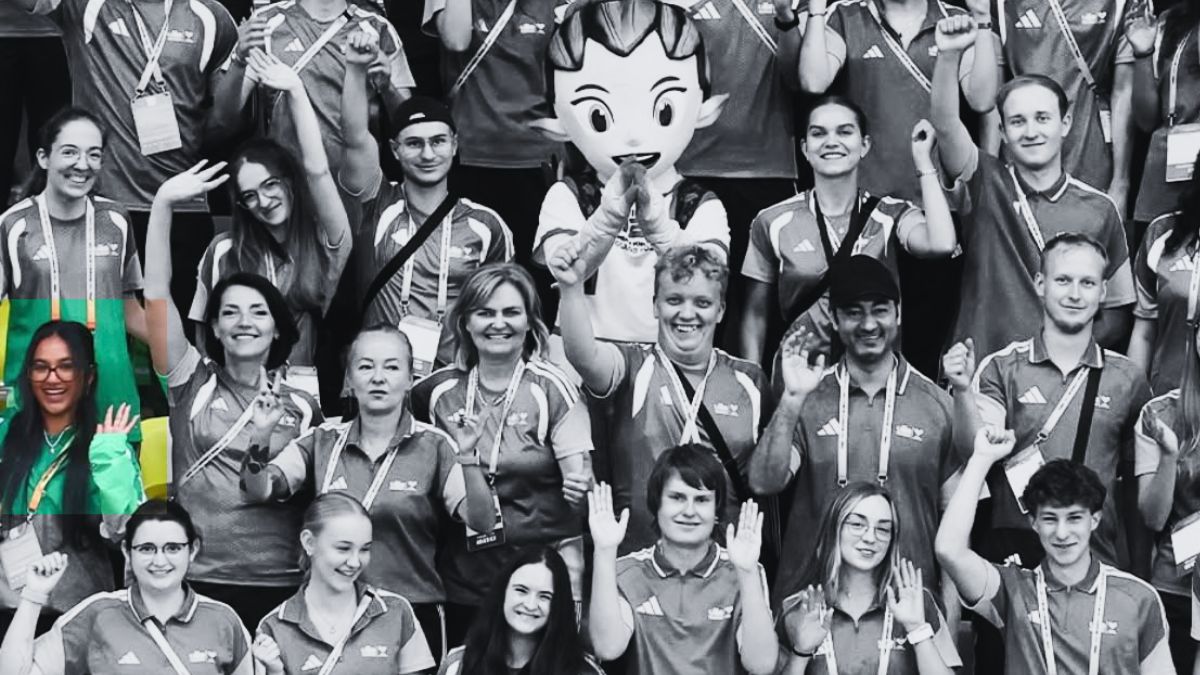
When I applied to volunteer at the FIFA u20 Women’s World Cup in Poland, I knew I wanted to experience something I hadn’t really seen before: the operational side of football.
I’ve spent a lot of time around football through writing, attending matches and engaging in grassroots football, but I had never experienced what goes on behind the scenes of a major international tournament.
I wanted to see how everything actually works- the staff, the organisation, the security, the matchday routines and all the little things that supporters probably never think about.
So when I saw the opportunity on the FIFA volunteer website, I filled out the application, completed an assessment and, a little while later, found out that I had been selected.
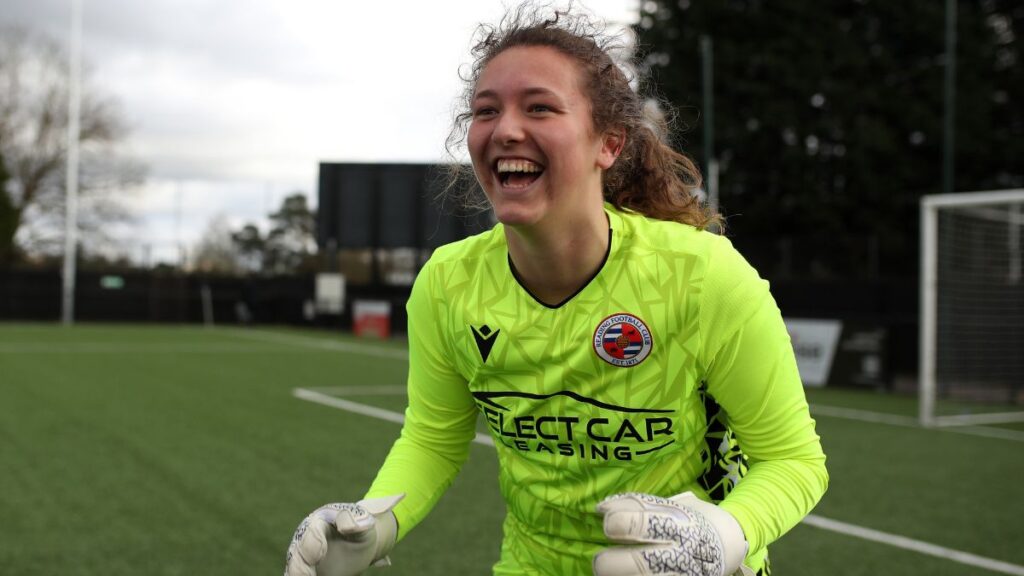
And I wasn’t the only Berkshire connection at the tournament. Berkshire born and raised, former Reading FC goalkeeper Eve Annets was in Poland representing England u20s, although unfortunately I didn’t get the chance to watch her play during my time there.
When I was asked which location I wanted, I chose Katowice… although I had never heard of Katowice before.
However, as it turned out, I was going to have a brilliant time there.
My welcome to Katowice
Although I had absolutely zero idea of what to expect, the southern Polish city immediately surprised me. Katowice itself was a really nice city, but what struck me most was how friendly everyone was. Pretty much everyone seemed to speak at least some English, and whenever I needed help, people were incredibly welcoming. I booked an apartment in the city centre for the week, which turned out to be a really convenient base. It was only around a 10-minute drive from the stadium, so getting to and from my volunteer shifts was relatively straightforward. It also meant I was close enough to the city centre to head out and explore whenever I had some free time.
Then there was the tournament itself.
Before travelling to Poland, I completed the online volunteer training, which involved videos, quizzes and a Zoom call. But none of that quite prepared me for the moment I actually arrived.
I think the best way to describe my first impression was: wow, this is actually real.
Seeing the FIFA logo everywhere, walking around the stadium and seeing just how official and professional everything was was slightly overwhelming. There was something about seeing all of the tournament branding and security measures in person that made it hit home that I wasn’t just going to watch a few football matches.
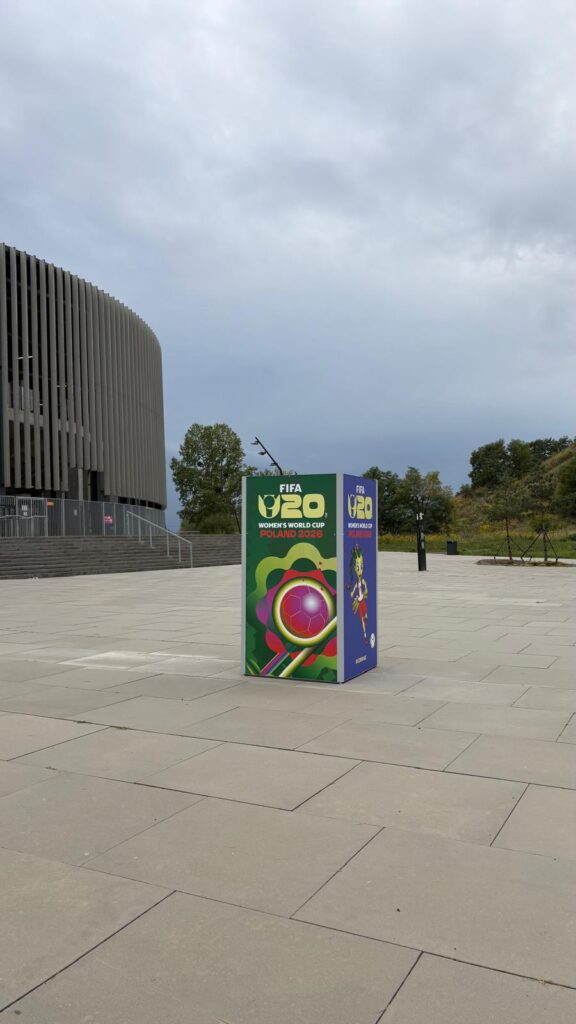
I was at a FIFA World Cup.
And, admittedly, there was a little bit of fangirl excitement involved too.
My first matchday
It started with collecting my accreditation outside the stadium.
I found the entrance, went through the media entrance, showed my accreditation, got scanned by security and had my bag checked. That became something I quickly got used to- every time you entered the stadium, there were security checks and procedures to go through.
I headed up to the Volunteer Centre, checked in and was given my volunteer kit… and what a kit it was.
A brand-new Adidas tracksuit, top, polo shirt, zip-up jacket, windbreaker, socks, bucket hat, a pair of Adidas trainers, a FIFA thermos and an Adidas cross-body bag.
Basically, I was kitted out better than I had expected.
While waiting around, I played cards with a few of the other volunteers and started making friends. One of the girls I met was from Cameroon, and we ended up having lunch together in the stadium restaurant.
The food was Polish and so good. It was also a nice opportunity to chat and, thanks to her, practise my French as well.
Eventually, I was shown where I would be working for the day. Each matchday at the stadium saw two matches, so I knew I had a long shift ahead.
This day I had been assigned to ticketing, although with the amount of security around the stadium, I was told there wouldn’t actually be a huge amount for me to do. When supporters started arriving, I helped direct people and point them in the right direction, but after things settled down, some of the other volunteers told me I could head in and watch the matches.
I wasn’t exactly going to complain about that.
So I watched the football.
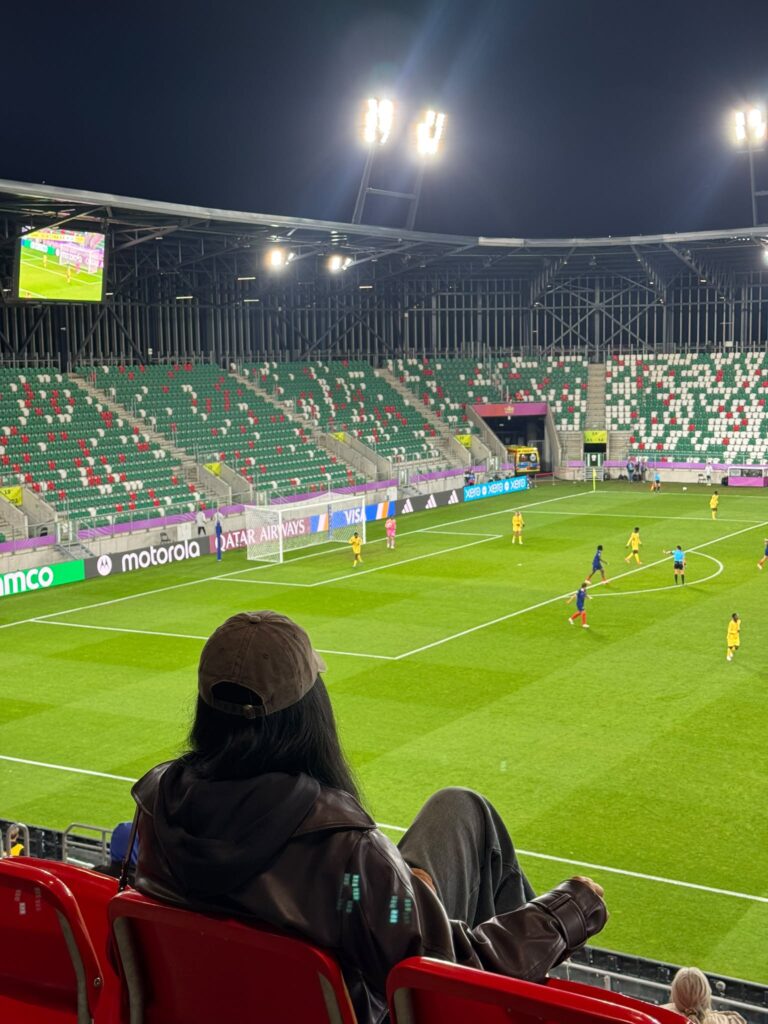
During the second match, I noticed a few people taking photos and offered to take one for them. We got chatting, and I soon discovered that the people I had just met were actually football agents.
They were there scouting talent and watching some of their clients play.
We ended up talking for ages, and I learnt about just some of the things that go into being a football agent, notably the travelling. We exchanged social media details and went our separate ways.
I thought that was probably where the interaction would end.
It wasn’t.
From FIFA volunteer to France-Ghana Spectator
The next day, we were messaging when they invited me to join them for the France vs Ghana game in Sosnowiec.
Completely spontaneous.
As Liverpool fans, we somehow ended up finding a local sports bar to watch the Liverpool game together before heading over to the match.
This was probably one of the most unexpected moments of the whole trip.
I had travelled to Poland to volunteer at a FIFA tournament, and somehow I’d ended up making friends with football agents I’d randomly met on my first matchday- and then going to another World Cup match with them.
It wasn’t something I had planned at all, but it quickly became one of the core memories of the trip.
Pierogi, Portugal and a day in Kraków
The following day was a little more relaxed, so I spent some time exploring Katowice.
I was on a mission to find one thing in particular: pierogi.
I’d obviously heard about traditional Polish dumplings before travelling, so I couldn’t leave without trying them.
I spent a couple of hours walking around the city centre, taking in the local sights and churches before eventually finding a restaurant serving pierogi.
They were brilliant.
The other thing that surprised me was the size of the portions. I was expecting a nice little plate of dumplings, but the restaurant I found myself at had served me enough food to make me question whether I had accidentally ordered for an entire family.
Still, I wasn’t complaining.
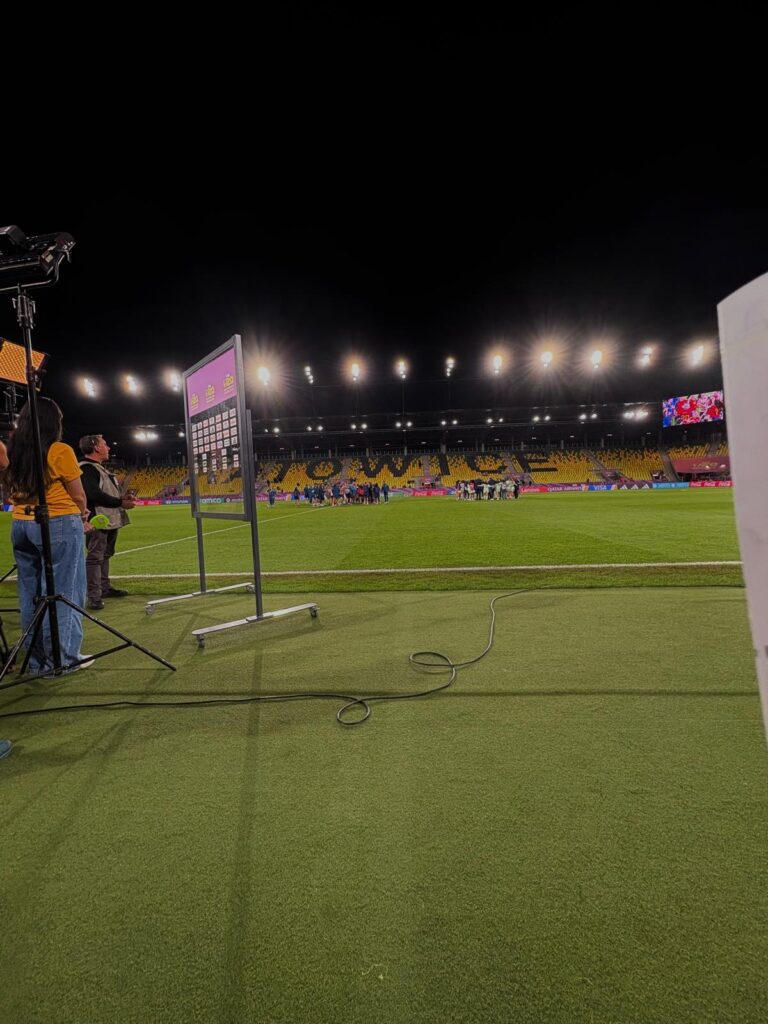
Then I noticed that Portugal were playing their final group-stage match against Costa Rica.
They needed a win to guarantee their place in the next round.
So, naturally, I went back to Sosnowiec.
I made my way to the top of the stand, surrounded by Portugal supporters proudly waving their flags and shouting down towards the pitch.
And when the Portuguese shout, they shout.
Portugal eventually won, and they couldn’t contain their happiness and relief. There was singing, dancing, and even the players and staff throwing eachother in the air at the final whistle.
It was one of those moments where you realise that international football is about so much more than what happens on the pitch. People had travelled across countries to support their team, and for them, that result meant everything.
The following day, I decided to make the most of being in Poland and took an early train to Kraków.
Why not?
It was only about an hour away, and I figured I might as well explore while I was there.
I found a little café for lunch and then walked around the Jewish Quarter, reading the plaques and seeing the memorials and statues relating to the Second World War. It felt like a walking history lesson.
From there, I made my way towards the main square, tried some Polish ice cream that had been recommended to me, saw more historic buildings and eventually found myself in a fun house filled with optical illusions, mirror mazes and VR headsets.
It wasn’t exactly the historical sightseeing itinerary I’d initially planned, but it was fun.
By around 6pm, I found a cosy, dimly lit restaurant for dinner before heading back to the train station for my journey to Katowice.
A quiet day at the Volunteer Centre
The next day was supposed to be a shift at the Volunteer Centre.
Compared with a matchday, it was much quieter. There wasn’t quite the same sense of rushing around, so there was more time to sit down, have a coffee, eat something and actually get to know the other volunteers.
I met people from different countries and backgrounds, and it was interesting hearing how everyone had ended up volunteering at the same tournament.
I also became friends with a girl from Wales who was working around the Volunteer Centre and had experience of anti-doping duties.
She explained what the role involved and what she had been doing during her shifts.
At the time, I remember thinking it sounded really interesting.
Little did I know that the next day, I’d be doing it myself.
“How would you feel about joining me on anti-doping duty?”
I arrived back at the Arena Katowice the following morning expecting another shift in ticketing.
I checked in, grabbed a morning coffee and sat down with some of the other girls before the shift started.
We were playing a card game when the girl from the previous day came over and pulled me to the side.
“How would you feel about joining me on anti-doping duty today?”
Instantly, I said yes.
“One of the volunteers hasn’t turned up, so we need someone to fill in. And with Brazil playing first and then Portugal playing afterwards, I told them you’d be perfect for the job because you speak Portuguese.”
And just like that, my day had completely changed.
I followed her down to the doping control room, where I met the FIFA Doping Control Officer on shift, Paola Lopez from Ecuador.
We had a briefing lasting around 20 minutes, where we were talked through what our responsibilities would be and what we could expect throughout the day.
The role involved being assigned a player and keeping an eye on them during the latter stages of the match. We needed to know whether they were on the pitch or on the bench and, after the final whistle, remain with them as they made their way through to doping control.
It was a responsibility I hadn’t expected to have when I woke up that morning.
And suddenly, I was about to spend the day chaperoning international footballers.
Brazil
For the first match, I was assigned to the Brazil captain.
We spent the whole match pitchside, enjoying the football and feeling the excitement from the Brazilian bench beside us.
When the final whistle was blown and my player began walking off the pitch, I went over and explained in Portuguese that she had been selected for an anti-doping test.
I noted the time and escorted her through the tunnel.
She had also been named Player of the Match, so before going to doping control, we passed through the media zone where she collected her trophy, celebrated with her teammates and took a few photos.
Eventually, we made our way to the doping control room.
The FIFA Doping Control Officer explained the process, and the Brazil team doctor joined us.
Then we waited.
And waited.
And waited.
I remember wanting my player to feel as comfortable as possible during what was obviously quite a long process. At one point, I told her she was welcome to take a bottle of water from the fridge.
She asked me to get one for her.
Unfortunately, I had to explain that I wasn’t allowed to touch anything she was going to consume, so she had to help herself.
One bottle became two.
Then three.
Then four.
Then five.
Eventually, after around two hours, she was ready to provide her sample.
But the thing I remember most wasn’t actually the waiting.
It was the conversation.
I found myself chatting to the other Brazil player in the room. She told me about her life, including studying at university in Brazil alongside playing football, and travelling all the way to Poland to represent her country.
And she was just as interested in me. She wanted to know how I spoke Portuguese, where I was from and why I’d travelled all the way to Poland. She even asked about the other volunteers and where everyone had travelled from.
At one point she asked me:
“If England don’t make it through, who will you support?”
I said that because of my soft spot for Portugal, maybe I’d support Portugal.
She looked at me.
“No, I mean Brazil. I would support Brazil.”
“Ah yes, I think you should support Brazil,” she laughed.
It was such a small interaction, but it summed up the whole experience for me.
I had been given an unexpected responsibility, but it had also created an opportunity to have a completely normal conversation with someone whose life was so different from mine.
Portugal vs Spain
By the time my player had completed the process, the second match, Portugal vs Spain, had already kicked off.
We watched the start of the game on the big screen in the doping control room.
Spain scored early, which wasn’t exactly a surprise given the 16 goals scored in their three game group stage.
Then, just before half-time, Portugal had a player sent off.
Everyone in the room immediately looked at each other.
We knew that if the red-carded player was selected for anti-doping control, things could become considerably more complicated.
Eventually, we received the player we were responsible for, and I breathed a sigh of relief when I saw her still on the pitch.
Once again, I informed her and escorted her through to the doping control room.
One of the rules we’d been given was that the player had to remain in front of us at all times, so that we could keep them within sight, and we weren’t allowed to touch them.
This time, the experience was very different.
My player was clearly upset. Portugal had just been knocked out of the tournament, and she didn’t really want to eat or talk.
So I left her to take everything in.
Then the Spanish players arrived, understandably much happier after progressing, which created a slightly strange atmosphere in the room.
Fortunately, the other Portuguese player was in much better spirits and did her best to lift the mood.
She was incredibly chatty and witty, and I enjoyed hearing her story too.
She had been born and raised in Germany, where she still lived and played football, but represented Portugal through her Portuguese family.
Once again, I found myself having a conversation that I simply hadn’t expected to have when I applied to be a volunteer.
After another few hours of waiting and chatting, all of the players had completed the process and left.
We said our goodbyes, I thanked Paola for the opportunity and we finally made our way home.
Goodbye, Poland
The taxi ride back to my apartment was bittersweet.
I was still buzzing from what had probably been the most fascinating day of the entire trip. Just a few hours earlier, I had been sitting in a doping control room watching a World Cup match on a big screen and speaking Portuguese with international footballers.
But at the same time, I knew it was over.
I was leaving the next morning.
Looking back, what started as an application on the FIFA volunteer website turned into a week that was far more memorable than I could have imagined.
I got to experience a major international tournament from behind the scenes, but I also got to explore Poland, watch matches I hadn’t originally planned to attend, eat far too many pierogi, make friends from different countries and have completely unexpected conversations with people I would never otherwise have met.
Most importantly, I got a glimpse of what goes into making an international football tournament happen.
As a football fan, seeing the FIFA branding everywhere and watching the matches was exciting enough. But being on the other side of the accreditation barriers, seeing the volunteers, security teams and tournament staff working behind the scenes, gave me a completely different perspective.
And perhaps the biggest lesson was that you never quite know where saying yes will take you.
I went to Poland expecting to spend a few days helping with ticketing.
Instead, I came home having chaperoned the Brazil captain through an anti-doping process, learned what goes into being a football agent, made friends with people from all corners of the world, explored Kraków, eaten my weight in pierogi and collected a week’s worth of memories that I certainly wasn’t expecting when I clicked “Apply”.
Not a bad way to spend a week.
PakarPBN
A Private Blog Network (PBN) is a collection of websites that are controlled by a single individual or organization and used primarily to build backlinks to a “money site” in order to influence its ranking in search engines such as Google. The core idea behind a PBN is based on the importance of backlinks in Google’s ranking algorithm. Since Google views backlinks as signals of authority and trust, some website owners attempt to artificially create these signals through a controlled network of sites.
In a typical PBN setup, the owner acquires expired or aged domains that already have existing authority, backlinks, and history. These domains are rebuilt with new content and hosted separately, often using different IP addresses, hosting providers, themes, and ownership details to make them appear unrelated. Within the content published on these sites, links are strategically placed that point to the main website the owner wants to rank higher. By doing this, the owner attempts to pass link equity (also known as “link juice”) from the PBN sites to the target website.
The purpose of a PBN is to give the impression that the target website is naturally earning links from multiple independent sources. If done effectively, this can temporarily improve keyword rankings, increase organic visibility, and drive more traffic from search results.