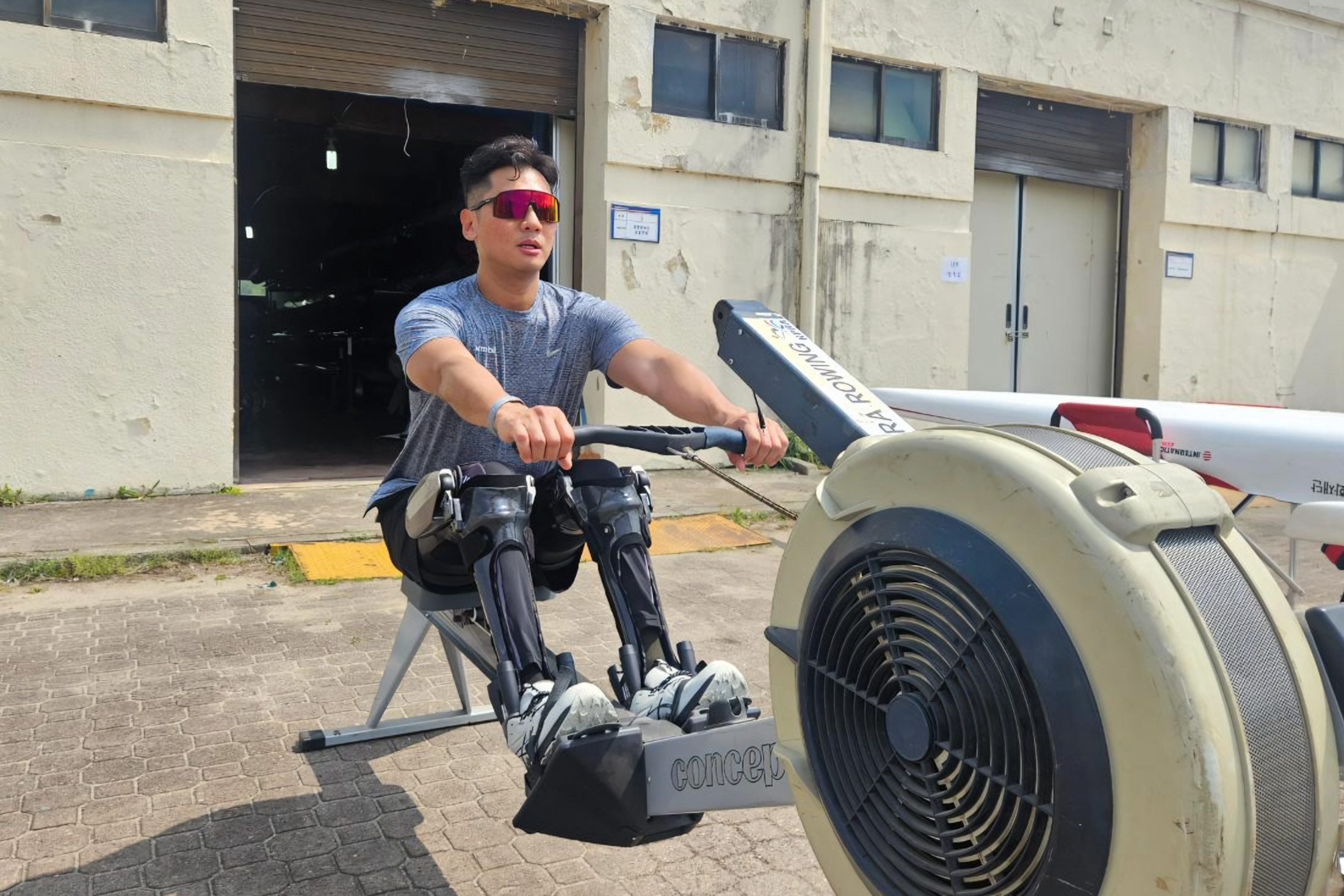
Rower Chu Yeon-hee of the Netmarble Rowing Team trains on a rowing machine at Misa Regatta Park in Hanam, Gyeonggi Province, June 15. Korea Times photo by Kim Kyung-joon
For Chu Yeon-hee, 40, one day in April 2008 changed everything.
At the time, Chu was in his third year as a noncommissioned officer (NCO) working as an aircraft mechanic with an Army aviation unit. While moving equipment, Chu fell from the fourth floor of a building. Rushed to a civilian hospital, Chu underwent an eight-hour operation in which surgeons inserted eight metal screws into his first through fourth lumbar vertebrae. The damaged spinal nerves never recovered.
No matter how hard Chu concentrated, not even a single toe would move. Doctors diagnosed him with incomplete paralysis of the lower body caused by damage to the cauda equina — the bundle of nerves at the base of the spinal cord resembling a horse’s tail. A military career was no longer possible.
Chu had fulfilled a family tradition by becoming the third consecutive generation to serve as an NCO in 2006. Proud of that legacy, he had begun training to become an Army helicopter pilot and warrant officer when the accident abruptly ended the first chapter of life.
Although despair overwhelmed the 22-year-old, Chu eventually found the strength to begin again.
When the Hankook Ilbo met Chu on June 15 at the Misa Regatta Park in Hanam, Gyeonggi Province, Chu was already moving on with his life. It was not a comeback he achieved alone. Family members and friends remained steadfast, helping him keep his determination to overcome his disability.
Chu Yeon-hee carries his training boat and equipment at Misa Regatta in Hanam, Gyeonggi Province, June 15. Before receiving robotic prosthetic legs, he had to rely on his teammates for help moving equipment. Korea Times photo by Kim Kyung-joon
Promising soldier’s shattered dreams
Standing 184 centimeters tall and having exceptional athletic ability, Chu had excelled in sports from an early age. While attending the Army NCO Academy, Chu was selected for the taekwondo demonstration team, and years of skiing had developed skills comparable to those of ski patrol members. Having always relied heavily on his strong legs, Chu initially believed the paralysis could be overcome. Even immediately after the accident, his only thought was to complete rehabilitation as quickly as possible and return to his unit.
That confidence soon gave way to disappointment and eventually despair. Without something to hold onto, Chu could not remain standing for even a minute. His thighs grew thinner by the day, and even standing up or sitting down became difficult. The diagnosis of permanent disability became impossible to deny.
Chu Yeon-hee before the 2008 accident / Courtesy of Chu Yeon-hee
Just four months after the accident, Chu was medically discharged from the military. HIs dream of becoming a helicopter pilot vanished, replaced by fears the life he had planned might be over before it had really begun.
The financial burden was crushing. In addition to paying for surgery and rehabilitation at a civilian hospital, Chu even received a bill for the ambulance ride on the day of the accident.
“To receive financial compensation from the government, I had to prove just how seriously I had been injured and how much I had suffered,” Chu recalled. “The more I demonstrated my weakness by appearing on crutches or in a wheelchair, the more insignificant I felt. My determination to remain a proud member of society gradually withered.”
Lifted from despair by family
It was his family that ultimately helped Chu stand again. Chu’s father took on the practical battles, personally challenging the government in court after authorities denied him compensation and veteran benefits.
While the father fought for justice, Chu’s mother pointed toward the future. “She told me that the real disability is limiting yourself because your body isn’t perfect,” Chu said. “She suggested I improve my English and study in the United States, where accessibility for people with disabilities is much better.”
One year and four months after the accident, in August 2009, Chu left for the United States, using his insurance compensation to finance the trip. After studying there for two years, Chu returned to Korea. Rehabilitation continued throughout that time, and recovery progressed to the point where Chu could walk independently with leg braces, without using crutches.
Back in Korea, Chu’s first job was teaching at an English village, where he met Choi Soo-an, a fellow instructor who would later become his wife.
Chu Yeon-hee competes as a member of Korea’s national para rowing team. Courtesy of Chu Yeon-hee
“When I proposed, I asked whether she was okay with marrying someone with a disability,” Chu said. “She told me that the real disability is a sick mind, not a physical limitation. She also said that even if we move slowly or need to rest from time to time, as long as we’re heading in the right direction, she’ll always walk beside me.”
“Whenever I begin to lose confidence, those words still give me the strength to keep moving forward.”
Finding freedom in water
Leveraging his experience as an aircraft mechanic and fluency in English, Chu changed jobs twice after returning to Korea. First he taught cadets at his alma mater before joining the National Aviation Museum when it opened in 2020 as a curator and researcher.
For a father of a young daughter, now 10, a permanent position at a public institution seemed ideal. It offered stable income for the family of three and allowed Chu to work in the aviation field and make use of his passion and expertise.
But another obstacle soon emerged. Spending long hours in front of a computer caused his already weakened body to become even stiffer. Family outings also underscored his physical limitations. Even standing in line at a cafe to order drinks proved difficult. Carrying his exhausted daughter or steadying her bicycle always fell to Chu’s wife.
When people questioned why Chu would leave a secure government job, the answer was simple. “Because I wanted to live,” Chu said. That realization changed everything.
Chu Yeon-hee, right, and his family walk together in a marathon hosted by the Defense Daily at Peace Park in Mapo District, Seoul, Sept. 27, 2025. Courtesy of Chu Yeon-hee
Instead of thinking, “My body isn’t strong enough, so I should find a desk job,” Chu decided, “Because my body isn’t strong, I need work that helps me become stronger.”
Looking for a sport that relied primarily on upper-body strength, Chu came across canoeing through the website of the Korea Paralympic Committee.
Coaches quickly recognized his natural athletic ability, and Chu later transitioned to rowing. In 2024, Chu joined the para rowing team of SH Seoul Housing & Communities Corp. In his first season with the team, Chu captured multiple medals at the National Para Games, including gold in the men’s double event with Ha Jae-heon, a military veteran who lost both legs in a 2015 landmine explosion in the Demilitarized Zone.
Ha Jae-heon, a retired staff sergeant who lost both legs in an explosion in the Demilitarized Zone, enters the “Conversation Table with National Heroes” event after an honor guard inspection at the then-presidential office in Yongsan, Seoul, June 9, 2022. Yonhap
Finding new purpose with wounded veterans
Education and family defined the second chapter of Chu’s life. Rowing opened the third.
On the water, Chu discovered a sense of freedom. Pushing through races as his heart rate climbed to 185 beats per minute brought him an overwhelming awareness of being alive. Last year, Chu earned a place on Korea’s national para rowing team.
The greatest change came not from the sport itself, but from the people it introduced him to.
Through rowing, Chu met fellow wounded veterans and was introduced to Purple Heart, an organization that supports the treatment, rehabilitation and restoration of dignity for injured service members.
“For the first time, I realized I wasn’t alone,” Chu said.
Since last year, Chu has participated in Purple Heart’s peer support meetings for wounded veterans, sharing personal experiences with others facing similar struggles.
Chu Yeon-hee draws a bow while blindfolded during the Warrior PATHH program in Texas in February. Courtesy of Chu Yeon-hee
Earlier this year, Chu also completed Warrior PATHH, a U.S.-developed civilian rehabilitation and training program designed for military personnel, police officers and firefighters suffering from severe post-traumatic stress disorder, or PTSD. Rather than focusing solely on treatment, the program aims to foster post-traumatic growth, helping participants transform trauma into personal development. Purple Heart plans to adapt the program for use in Korea.
Chu has also spoken at policy seminars organized by the group at the National Assembly, drawing on personal experiences to advocate for expanded support for wounded service members and simpler administrative procedures.
The suffering once endured alone has now become a source of support for others walking the same path.
‘Opportunities come to those who prepare’
In 2024, Chu received a state-of-the-art robotic leg brace through a support program for veterans sponsored by the POSCO 1% Foundation.
“I can now walk without swaying and move almost like someone without a disability,” Chu said. “I can stand comfortably for hours. What may seem like a small change has completely transformed my quality of life.”
The device has also allowed Chu to enjoy moments that once seemed unimaginable with his daughter. “I can carry her on my shoulders and play baseball with her,” Chu said with a smile. “Those were things I never thought I’d be able to do.”
Expressing gratitude to the foundation’s donors, Chu added, “I’m deeply thankful and feel a great sense of responsibility toward the countless people I will probably never meet who donated just 1 percent of their salaries to give someone like me a completely new life.”
A staff member from the Korean branch of Ottobock, the German manufacturer of the C-Brace robotic prosthetic leg, checks the settings of the device worn by Chu Yeon-hee, at Misa Regatta Park in Hanam, Gyeonggi Province, June 15. Korea Times photo by Kim Kyung-joon
Chu’s next goal is to win a gold medal at the 2029 Invictus Games, the international sporting event for wounded, injured and sick service personnel and veterans. If Daejeon is selected as host city, it would be the first Asian city to stage the event.
For now, Chu is training with the Netmarble para rowing team, determined to earn another place on the national squad next year.
Before ending the interview, Chu offered a message to others living with physical disabilities. “Building basic physical strength through exercise was the first piece of the puzzle,” Chu said. “Even the most advanced assistive devices require physical conditioning to use effectively. And opportunities offered by companies or support organizations are easily missed if you aren’t prepared.”
“But I believe our society rewards those who keep working hard. If you prepare and persevere, someone will eventually reach out a helping hand. I hope to contribute, even in a small way, to building that kind of society.”
This article from the Hankook Ilbo, the sister publication of The Korea Times, is translated by a generative AI system and edited by The Korea Times.
PakarPBN
A Private Blog Network (PBN) is a collection of websites that are controlled by a single individual or organization and used primarily to build backlinks to a “money site” in order to influence its ranking in search engines such as Google. The core idea behind a PBN is based on the importance of backlinks in Google’s ranking algorithm. Since Google views backlinks as signals of authority and trust, some website owners attempt to artificially create these signals through a controlled network of sites.
In a typical PBN setup, the owner acquires expired or aged domains that already have existing authority, backlinks, and history. These domains are rebuilt with new content and hosted separately, often using different IP addresses, hosting providers, themes, and ownership details to make them appear unrelated. Within the content published on these sites, links are strategically placed that point to the main website the owner wants to rank higher. By doing this, the owner attempts to pass link equity (also known as “link juice”) from the PBN sites to the target website.
The purpose of a PBN is to give the impression that the target website is naturally earning links from multiple independent sources. If done effectively, this can temporarily improve keyword rankings, increase organic visibility, and drive more traffic from search results.