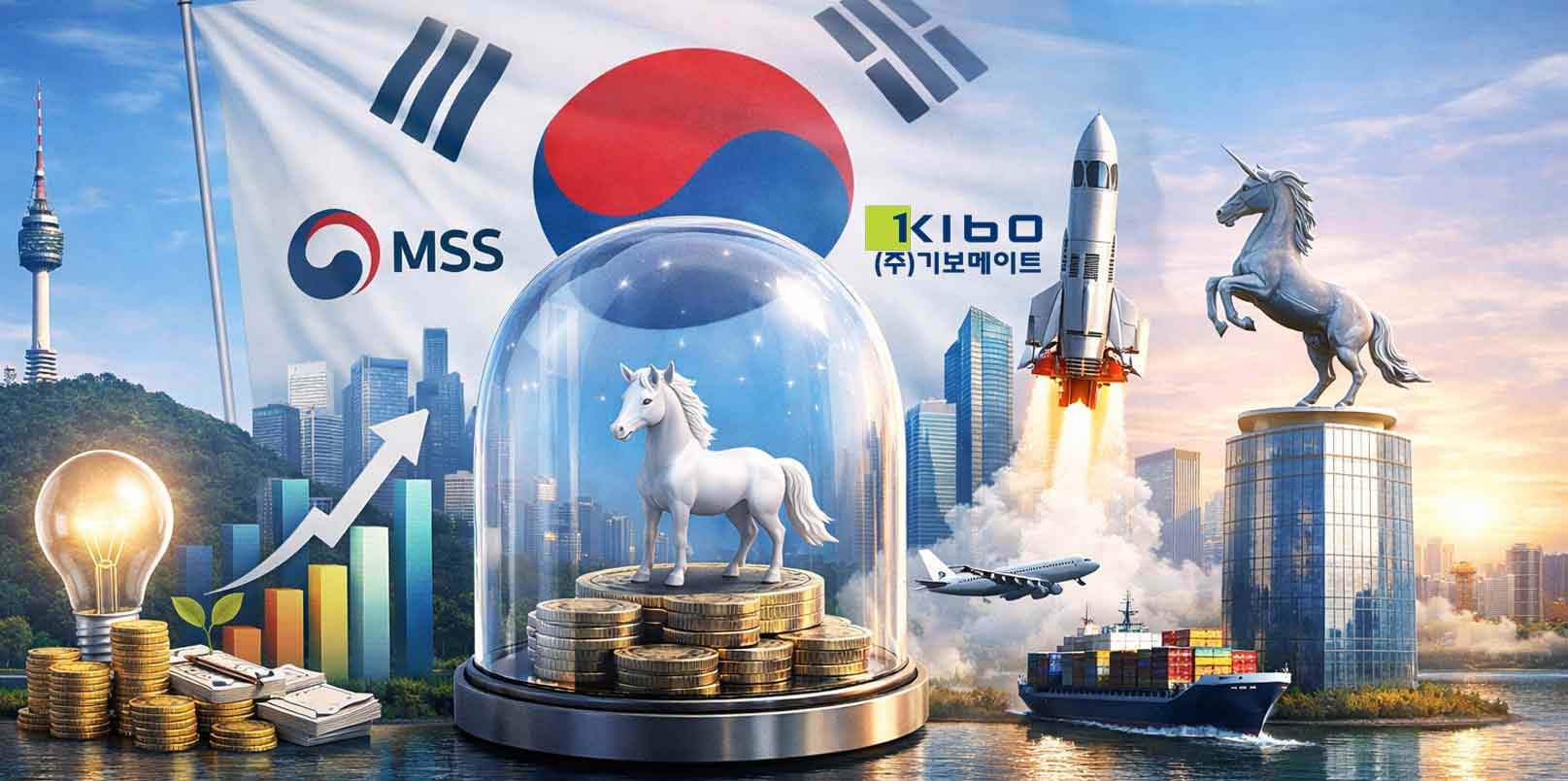
South Korea has built an unusually structured pathway to turn promising startups into global contenders. At the center of that system sits the Baby Unicorn program, a policy designed to spotlight high-growth companies before they reach billion-dollar valuations. The label attracts attention across Korea’s venture ecosystem. The deeper question is what it actually changes once a startup earns the designation.
Korea’s “Baby Unicorn” Label Signals a New Stage in Startup Policy
South Korea’s startup policy has evolved beyond early-stage incubation. Government programs increasingly target companies that already demonstrate traction and now need capital, credibility, and global market access to scale.
The Baby Unicorn program, operated by the Ministry of SMEs and Startups (MSS), sits at the center of that shift. It is part of Korea’s broader Global Unicorn Project, a national effort designed to increase the number of high-value startups capable of reaching billion-dollar valuations.
The label has become a prominent signal within Korea’s venture ecosystem. Yet the real question is practical rather than symbolic. Does the designation unlock meaningful capital access, or does it mainly serve as policy recognition for startups already validated by the market?
Understanding that distinction helps explain how Korea’s scale-up policy actually works.
What the Korea Baby Unicorn Program Actually Is
The Baby Unicorn program identifies startups that have already demonstrated growth potential through investment traction or valuation milestones. The designation targets companies that have moved beyond early experimentation but have not yet reached full unicorn scale.
According to MSS program criteria, eligible companies must be registered venture firms and show evidence of market validation through cumulative investment or valuation benchmarks. Korea’s Unicorn policy framework treats Baby Unicorn companies as preliminary level before pre-unicorn scale-ups, firms that have the potential to cross the next valuation threshold with additional support.
This structure reflects Korea’s staged approach to startup policy. The government does not attempt to manufacture unicorns through direct capital injections. Instead, it tries to identify companies that the market has already partially validated and then provide policy tools to accelerate their next phase of growth.
That positioning explains why the program sits inside the larger Global Unicorn Project rather than within early-stage startup creation initiatives.
What Selected Startups Actually Receive
The Baby Unicorn designation comes with several policy instruments designed to reduce financial and operational friction during the scale-up phase.
Selected companies can receive market development funding of up to KRW 300 million to support commercialization and global expansion activities. The program also connects companies to government-linked financial tools.
One of the most significant mechanisms is a special guarantee facility that can reach up to KRW 5 billion, delivered through technology guarantee institutions. These guarantees do not represent direct government investment. Instead, they improve a startup’s ability to secure financing by reducing lender risk.
Additional policy support can include investment attraction programs, global expansion assistance, and access to networks that link startups with venture investors and industry partners.
Taken together, the program does not simply hand startups large capital checks. It adjusts the financing conditions around them.
Why the Label Matters in the Venture Ecosystem
Within Korea’s startup ecosystem, the Baby Unicorn designation functions as a credibility marker.
Selection signals that a company has passed a government screening process based on measurable growth indicators. For venture investors, that signal can reinforce an existing investment thesis or highlight companies that have reached a scale worth closer examination.
However, the designation does not replace market validation. Startups selected for the program typically already show evidence of investor confidence through previous funding rounds or valuation signals.
In other words, the state does not choose companies at random and then attempt to create unicorns around them. The program largely operates in the opposite sequence. Market traction comes first, followed by policy recognition.
That sequencing is an important distinction for international observers who may interpret the program as a form of government-driven venture selection.
Korea’s Policy Ladder for Scale-Stage Startups
The Baby Unicorn program also reveals how South Korea has structured a policy ladder designed to support startups at different growth stages.
Early-stage companies receive support through incubation, R&D programs, and venture funding initiatives. Once companies reach the scale-up stage, programs like Baby Unicorn step in to reinforce credibility and financing access.
The Global Unicorn Project extends this ladder further. Companies that demonstrate stronger growth can move into subsequent policy categories designed to support larger funding rounds and global market expansion.
This staged structure reflects a broader policy strategy. Korea is attempting to reduce the structural gap between promising startups and globally competitive scale-ups.
The Baby Unicorn program occupies the middle of that ladder.
Recognition Helps, but It Does Not Guarantee Unicorn Outcomes
Despite its visibility, the Baby Unicorn designation does not guarantee that selected companies will eventually reach unicorn status.
Policy support can reduce financial constraints and strengthen investor visibility. Yet the program does not eliminate the fundamental challenges of scaling a technology company.
Global expansion, sustained revenue growth, and competitive differentiation still determine whether a startup ultimately reaches a billion-dollar valuation.
Some Baby Unicorn companies have gone on to secure large investments, achieve public listings, or cross major valuation milestones. Others remain in earlier growth stages.
The label therefore functions best as a policy-backed scale-up signal, not a prediction of unicorn success.

Why Global Startup Observers Should Pay Attention
For global founders, investors, and ecosystem analysts, the Baby Unicorn program highlights a distinctive feature of Korea’s startup strategy.
Rather than focusing exclusively on early-stage innovation, Korea has increasingly concentrated policy attention on the difficult transition between startup and scale-up.
That transition is often where promising companies struggle. Capital requirements grow, international expansion becomes necessary, and operational complexity increases.
Programs like Baby Unicorn show how Korea is trying to address that stage through policy tools that combine recognition, financial guarantees, and international expansion support.
The approach reflects a broader ambition. Seoul is not only trying to create startups. It is trying to produce companies capable of competing at global scale.
Key Takeaways on Korea Baby Unicorn Program
- The Korea Baby Unicorn program is part of the government’s Global Unicorn Project aimed at nurturing scale-stage startups.
- Companies selected for the program already demonstrate market validation through investment or valuation benchmarks.
- Policy support includes market development funding and financial guarantees, rather than large direct investments.
- The designation acts as a credibility signal within Korea’s venture ecosystem, reinforcing investor attention.
- The program illustrates Korea’s broader strategy of building a policy ladder that supports startups as they transition into global scale-ups.
🤝 Looking to connect with verified Korean companies building globally?
Explore curated company profiles and request direct introductions through beSUCCESS Connect.
– Stay Ahead in Korea’s Startup Scene –
Get real-time insights, funding updates, and policy shifts shaping Korea’s innovation ecosystem.
➡️ Follow ngopihangat on LinkedIn, X (Twitter), Threads, Bluesky, Telegram, Facebook, and WhatsApp Channel.
PakarPBN
A Private Blog Network (PBN) is a collection of websites that are controlled by a single individual or organization and used primarily to build backlinks to a “money site” in order to influence its ranking in search engines such as Google. The core idea behind a PBN is based on the importance of backlinks in Google’s ranking algorithm. Since Google views backlinks as signals of authority and trust, some website owners attempt to artificially create these signals through a controlled network of sites.
In a typical PBN setup, the owner acquires expired or aged domains that already have existing authority, backlinks, and history. These domains are rebuilt with new content and hosted separately, often using different IP addresses, hosting providers, themes, and ownership details to make them appear unrelated. Within the content published on these sites, links are strategically placed that point to the main website the owner wants to rank higher. By doing this, the owner attempts to pass link equity (also known as “link juice”) from the PBN sites to the target website.
The purpose of a PBN is to give the impression that the target website is naturally earning links from multiple independent sources. If done effectively, this can temporarily improve keyword rankings, increase organic visibility, and drive more traffic from search results.