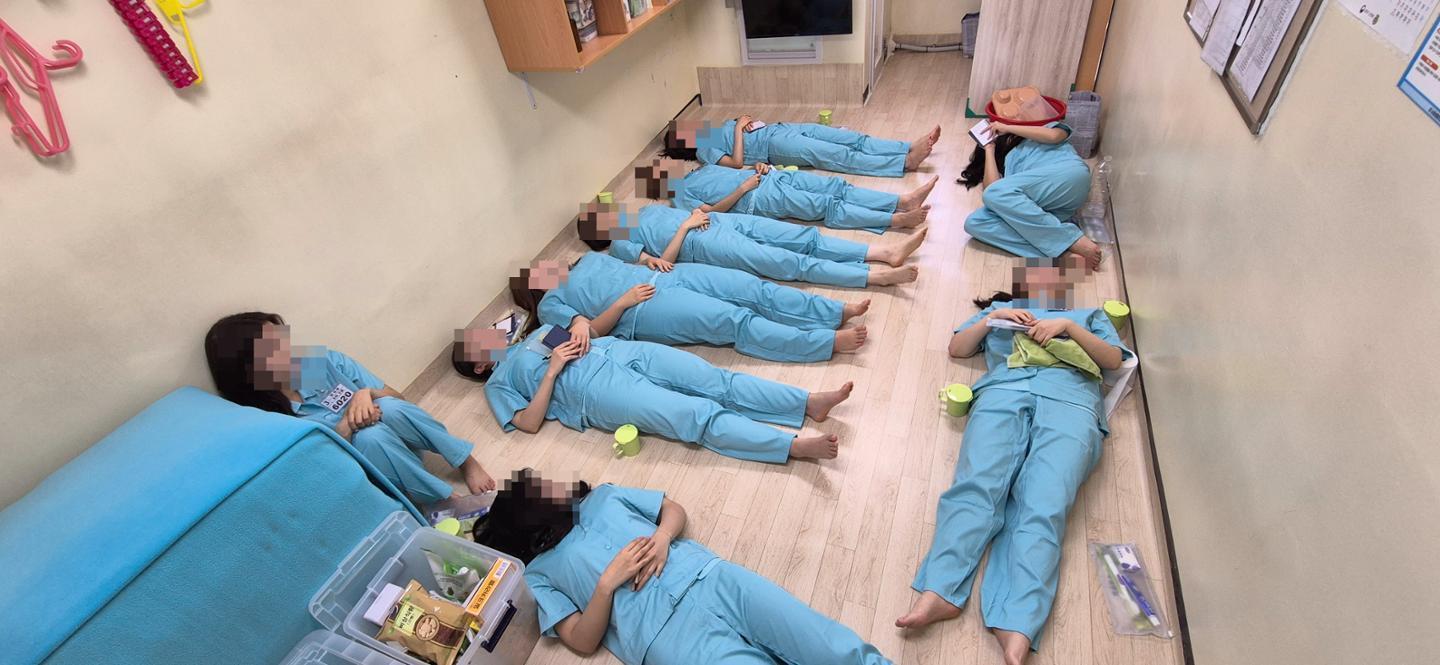
Reporters wearing prison uniforms experience inmates’ daily routines during the Justice Ministry’s on-site assessment of correctional facilities at Cheongju Women’s Prison in Cheongju, North Chungcheong Province, Wednesday. Cells designed for five inmates often house nearly twice that number. Courtesy of Ministry of Justice
With a metallic click, cold metal cuffs close around both wrists.
“You are now in custody.”
Suddenly, moving one’s arms freely becomes impossible. The discomfort sets in quickly, as even scratching one’s head becomes an awkward struggle inside the moving prison transport van.
But after passing through a firmly shut iron gate and arriving at Cheongju Women’s Prison, where pale yellow buildings surround a small exercise yard, the handcuffs suddenly seem like the least of one’s problems.
Inside one of the prison’s shared cells, the space is so cramped and crowded that there is barely enough room to stretch out an arm, even after the handcuffs are removed.
The grim reality is that Cheongju Women’s Prison is considered to be in better condition than most prisons in the country. As Korea’s only correctional facility exclusively for women, it is generally regarded as one of the better-equipped institutions. Yet even here, the persistent problem of overcrowding proved impossible to escape.
The Cheongju Women’s Prison was designed to accommodate 619 inmates at 100 percent capacity. According to authorities at the time of the visit, however, it was housing some 742 inmates, operating at 119.7 percent of capacity.
The overcrowding became more tangible upon entering the cells. Some shared cells designed for five inmates, each measuring just 16.45 square meters, were housing seven or eight. One cell held as many as 10 inmates crowded together.
In the cramped quarters, inmates sleep pressed close to one another, enduring each other’s breathing, snoring and every small movement throughout the night. Tensions run high, and fights break out over seemingly minor matters such as who uses the toilet first, sleeping arrangements and the assignment of lockers within easy reach. Correctional officers said many inmates ask to be moved to single cells.
A solitary cell at Cheongju Women’s Prison in Cheongju, North Chungcheong Province. Though cramped even for one person, the cell houses two inmates because of overcrowding. Courtesy of Ministry of Justice
At the same time, it is those correctional officers who must mediate conflicts, respond to complaints and attend to inmates’ psychological needs, which is why authorities say overcrowding places a heavy burden on them as well. More inmates mean more personnel and time are needed to supervise and escort them, resolve day-to-day conflicts, prevent incidents, handle requests for medical care and arrange counseling.
At Cheongju Women’s Prison, some 240 employees manage more than 740 inmates. Of them, just 18 are assigned to nighttime security duty each night, leaving each officer responsible for more than 40 inmates while patrolling housing units, responding to calls, remaining alert to emergencies and fielding complaints both large and small.
Despite being constantly exposed to the risk of assault, inmate self-harm and other unpredictable behavior, officers said they receive no separate hazard-duty allowance comparable to that provided to police officers and firefighters.
The problem of overcrowding is not confined to Cheongju Women’s Prison, but offers a glimpse of a nationwide crisis as correctional facilities increasingly operate beyond capacity. The average daily inmate population last year stood at 63,680, exceeding the nationwide capacity of 50,614 by more than 13,000.
The average occupancy rate was 125.8 percent. That was a jump of more than 20 percentage points in three years, from 104.3 percent in 2022. By comparison, prison occupancy rates in other major countries remain below 100 percent, including 47 percent in Japan and 86 percent in the United States.
Correctional officers restrain an inmate who became violent while being escorted at Cheongju Women’s Prison. Courtesy of Ministry of Justice
Correctional officers describe opening and locking the iron doors as only a small part of their job. From 6 a.m. each day, their task is to care for inmates and help prepare them for life after release.
“It is about saving one person’s life and, ultimately, protecting society as a whole,” one officer said. But that conviction is becoming increasingly difficult to hold on to in overcrowded cells.
A day that passes without incident is considered a lucky one. Sleep deprivation leaves inmates on edge and quick to lash out over even minor discomforts, with much of that anger directed at correctional officers.
This has led some to argue that more money must be invested in living conditions at correctional facilities, not simply to make life more comfortable for inmates, but to improve the prospects of rehabilitation and protect society after their release.
Based on last year’s budget, incarcerating one inmate cost about 28.64 million won ($18,500) annually. But if inmates return to society after merely serving out their sentences, not rehabilitated but more agitated and resentful, they may be more likely to commit crimes again, making the burden society must bear only to grow.
The reimprisonment rate last year, in fact, already stood at 21.2 percent, meaning roughly 1 in 5 released inmates returned to prison.
“Whether we like it or not, people who commit crimes will eventually return to society,” Justice Minister Chung Sung-ho said that day. “An environment like this will not lead to rehabilitation. It will only deepen their anger and discontent.”
Justice Minister Chung Sung-ho inspects Cheongju Women’s Prison in Cheongju, North Chungcheong Province, during the third on-site assessment of correctional facilities, Wednesday. Courtesy of Ministry of Justice
The Ministry of Justice is considering elevating the Korea Correctional Service, currently under the ministry’s jurisdiction, into an independent agency. Beginning late next month, it also plans to operate a temporary correctional reform committee for one year, with dedicated task forces under it to address prison overcrowding. The details, however, have yet to be finalized.
The housing units at Cheongju Women’s Prison are locked down at 4:30 p.m., after which no one is allowed in or out. A correctional officer who had just completed the head count was drenched in sweat, a sweat-soaked uniform clinging to the officer’s back.
“This really cannot go on,” the officer said in a hoarse voice. “Rehabilitation is simply not possible in an environment like this.”
For both the inmates behind the iron doors and the correctional officers tasked with eventually returning them to society, the prison’s overcrowded cells seemed far too small.
An inmate at Cheongju Women’s Prison causes a disturbance inside a protective cell. Courtesy of Ministry of Justice
This article from the Hankook Ilbo, the sister publication of The Korea Times, is translated by a generative AI system and edited by The Korea Times.
PakarPBN
A Private Blog Network (PBN) is a collection of websites that are controlled by a single individual or organization and used primarily to build backlinks to a “money site” in order to influence its ranking in search engines such as Google. The core idea behind a PBN is based on the importance of backlinks in Google’s ranking algorithm. Since Google views backlinks as signals of authority and trust, some website owners attempt to artificially create these signals through a controlled network of sites.
In a typical PBN setup, the owner acquires expired or aged domains that already have existing authority, backlinks, and history. These domains are rebuilt with new content and hosted separately, often using different IP addresses, hosting providers, themes, and ownership details to make them appear unrelated. Within the content published on these sites, links are strategically placed that point to the main website the owner wants to rank higher. By doing this, the owner attempts to pass link equity (also known as “link juice”) from the PBN sites to the target website.
The purpose of a PBN is to give the impression that the target website is naturally earning links from multiple independent sources. If done effectively, this can temporarily improve keyword rankings, increase organic visibility, and drive more traffic from search results.