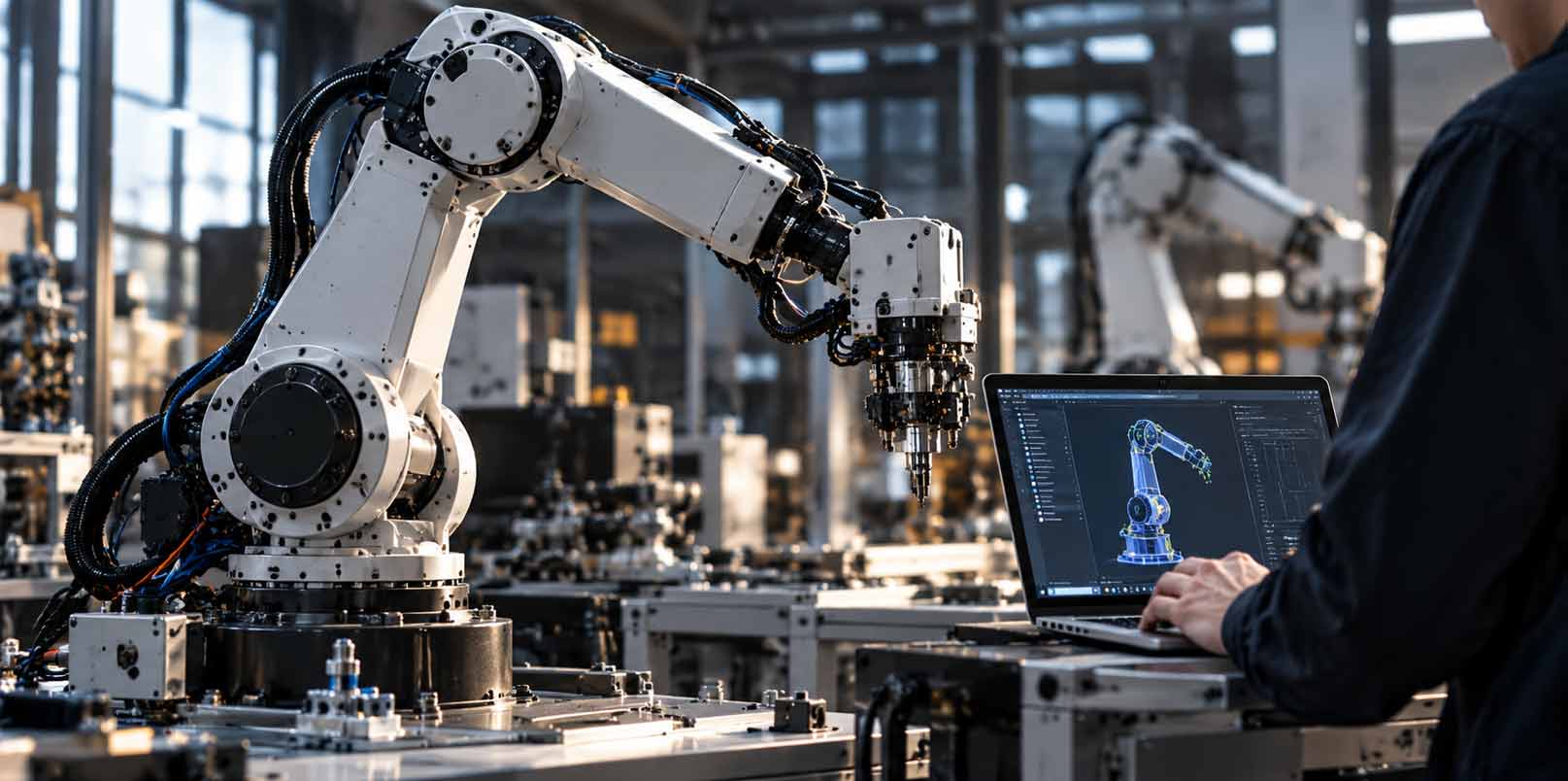
A robot-control program can be installed again, but the next robot may still refuse to move correctly. Its joints have different dimensions, its drives require particular settings, and its payload changes the forces the controller must handle. Each new machine therefore raises a question with financial consequences: which parts of the previous engineering work have become dependable assets, and which parts must be worked out again?
WIM Robotics Finds the Value of Reuse in Robot Configuration
For South Korean robotics startup WIM Robotics (WIM Inc.), building its first real-time robot-arm controller required several months of engineering. Today, CEO William Woojin Jun says the company can bring an already-supported robot to trajectory-following in approximately three business days.
The change reflects the accumulated technical foundation behind WIM’s PLEM robot control software, which the company has developed alongside its W-RC controller. During an exclusive interview with ngopihangat on its NVIDIA recognition, Jun explained how the company gradually reduced the engineering required to bring additional machines into its control environment.
“When we built our first real-time arm controller, almost everything had to be created: the real-time runtime on Jetson, EtherCAT communication and drive state handling, the trajectory pipeline, ROS 2 and API interfaces, logging, and a way to maintain compatibility across software versions,”
Jun said.
These components established the underlying environment needed to communicate with motors, execute robot movements, connect applications, and maintain software compatibility. Once that foundation existed, WIM could reuse it while concentrating more engineering effort on the characteristics of each new robot.
The experience suggests that the commercial value of robot control software may depend heavily on the configurations and integration knowledge accumulated around it. A company can develop a common control framework, but its usefulness across different machines depends on how much hardware-specific work has already been completed and verified.

Three Days for a Supported Robot, Three Weeks for an Unfamiliar Arm
Jun described a relatively structured process for bringing an already-supported robot into operation through PLEM.
On the initial day, engineers install the platform using a single script. They then scan the EtherCAT network, identify connected motors, and check that individual joints can move under control.
Over the following days, the team establishes payload and operating limits, adjusts control parameters, and tests planned trajectories. Jun said this sequence typically allows a supported robot to reach trajectory-following in approximately three business days, including preparation for customer handover.
However, WIM’s experience changes when the robot comes from a manufacturer the platform has not previously supported.
“For an arm from a manufacturer we had not supported before, the three weeks went into modeling, simulation validation in Isaac Sim, and drive communication,”
Jun explained.
Those three weeks represent work needed to establish compatibility with unfamiliar equipment. The original months of development covered the creation of core control infrastructure, while the three-day process applies when much of that infrastructure and the relevant hardware configuration already exist.
The engineering advantage lies in reducing the work required for subsequent installations, although the different project scopes may not establish a directly comparable reduction in labor costs.
But this still leaves robotics developers with an important planning question. When introducing another machine, how much time will engineers spend creating capabilities they have never built, and how much will they spend adapting components that have already been tested?

Robot Description Files Are Only Part of a Reusable Control System
The difference between bringing up a familiar robot and an unfamiliar one begins with how much the control system already knows about the machine. Robotics software can provide common functions and interfaces, but each robot still has mechanical characteristics and operating requirements that engineers must configure and verify.
The ros2_control framework allows developers to connect control software with different hardware through defined interfaces and plugins. Similarly, MoveIt’s robot-description framework uses standardized files to represent a robot’s mechanical structure, joint relationships, planning groups, and other characteristics needed for motion planning.
These tools help developers reuse common software while accommodating different machines. The remaining engineering work involves establishing accurate configurations and confirming that they perform as intended on the actual hardware.
“What remains per robot is its specific configuration: geometry and joint layout, mass, per-joint tuning values, payload, and safety limits,”
Jun explained.
For WIM, a previously supported robot can draw on configurations that engineers have already tested. Introducing an unfamiliar arm requires additional modeling, drive integration, and validation before its characteristics can become part of the supported environment.
A 2025 study published in Empirical Software Engineering examined 78 research publications, four major robotics frameworks, and 48 robotics subsystems. The researchers found that parameter reconfiguration was the only reconfiguration approach widely used in the systems they examined, highlighting the practical importance of managing machine-specific settings.
More recently, a University of Sheffield-led study published online in September 2026 examined how a ROS 2-based integration framework could organize manufacturing requirements, robot capabilities, and executable tasks into structured models. The research reflects continuing efforts to make robotic systems easier to adapt when equipment or production requirements change.
WIM’s experience brings that engineering challenge into the deployment process. Each validated robot configuration adds to the company’s accumulated knowledge of supported hardware, giving engineers a tested starting point when similar equipment is introduced in subsequent projects.

Incomplete Hardware Information Can Consume the Expected Savings
Reusable software still depends on accurate information about the machine it controls.
Jun said one recurring difficulty in WIM’s field experience involves obtaining and verifying motor specifications, drive configurations, brake timing, wiring details, and other equipment information. Even established documentation may require additional checks against the installed hardware.
“Not every robot manufacturer has complete documentation, and even when it exists, you have to verify that it matches the actual equipment,”
he said.
That uncertainty creates work beyond software installation. Engineers may need to inspect electrical connections, confirm drive behavior, adjust settings, and establish compatibility with equipment already present at the customer’s site.
To address these recurring tasks, WIM has developed standardized checklists for bringing up new robots, pre-delivery inspection procedures, and reusable software and hardware configurations. The company also maintains version and compatibility information for the software components used within its environment.
These procedures help turn individual engineering experiences into information that subsequent projects can use. A previously resolved wiring discrepancy or drive-setting problem can become part of a validated configuration instead of requiring another team to investigate it independently.
The commercial opportunity is therefore connected to reducing repeated investigation and verification work, not simply accelerating the installation of robot control software.
Korea’s Manufacturing Robot Programs Recognize the Integration Burden
Robot configuration management has particular relevance in South Korea, where industrial automation involves connecting robots with existing manufacturing equipment and production processes.
An April 2026 report by Electronic Times described system-integration expenses associated with industrial robot adoption, including fixture design, process connections, and control optimization. It also examined how Korean robotics suppliers are attempting to reduce integration requirements through more consolidated automation systems.
The Korea Institute for Robot Industry Advancement’s 2026 Advanced Manufacturing Robot Demonstration Program similarly includes process-design consultation, demonstration support, installation-related assistance, and workplace safety certification.
These activities show that Korea’s robot-adoption efforts extend beyond purchasing machinery. Industrial users also need engineering services that make the equipment suitable for their processes and operating environments.
WIM’s experience adds a narrower technical question to that picture: how much of the integration knowledge produced during one project can be preserved for later use?
A validated robot configuration cannot eliminate every installation-specific task. Industrial applications still require appropriate commissioning and safety work, as reflected in the international ISO 10218-2:2025 standard covering industrial robot applications and cells.
However, preserving verified information can reduce the amount of engineering that must be reconstructed before those application-specific tasks begin.
The Engineering Asset That Grows With Each Supported Robot
For Jun, the most valuable result of WIM’s development process is the technical knowledge accumulated as more machines enter its supported environment.
“The asset that keeps growing is not code volume. It is the library of validated robot descriptions and drive configurations, along with the integration experience needed to make the entire environment work reliably,”
he told ngopihangat.
That observation offers a useful way to evaluate the scalability of robotics hardware integration.
A growing software codebase may introduce functionality, but engineering efficiency also depends on the quality of reusable configurations, documented procedures, and compatibility information. Their value becomes clearer when a new project can use previous work without repeating the same setup and troubleshooting process.
WIM’s experience shows how validated configurations can turn previous engineering work into a practical advantage for subsequent robot installations. With established settings and tested procedures already available, engineers can focus more of their effort on the requirements of the specific machine and operating environment.
For Korean robot control software developers and their international customers, the value of reusability becomes visible in how much engineering work each new installation can inherit, reducing the need to repeat tasks that have already been completed and verified.
What Should the Eleventh Robot Tell an Investor?
A robotics startup may demonstrate technical progress by showing that its software supports more machines. However, a longer compatibility list tells investors relatively little about the engineering effort required to make each additional machine work.
A more revealing assessment would examine the time needed to configure a previously supported robot, the remaining engineering hours for unfamiliar hardware, the number of issues resolved through existing documentation, and the verification work required after software updates.
Those measurements would help establish how effectively accumulated technical knowledge reduces the cost of future engineering.
The question becomes particularly important when a company wants to expand beyond individual projects. If adding a customer repeatedly demands substantial custom development, revenue growth may continue to depend on expanding the engineering team.
But if each completed integration leaves behind verified assets that future engineers can reuse, the company has an opportunity to increase the number of machines it supports without rebuilding the same technical foundation every time.
For founders and investors evaluating industrial robotics, the next machine may therefore reveal more about software scalability than the first successful installation.
After ten robots have been integrated, what will the eleventh inherit that engineers no longer have to discover?

Key Takeaway
- Robot configuration management is a potential scalability asset. WIM Robotics CEO William Woojin Jun identifies validated robot descriptions, drive configurations, and accumulated integration knowledge as valuable reusable engineering resources.
- Supported and unfamiliar robots require different levels of work. WIM reports approximately three business days to bring an already-supported robot to trajectory-following, compared with about three weeks to bring up an unfamiliar manufacturer’s robot arm.
- Reusable control software still requires hardware-specific validation. Robot geometry, joint characteristics, payload settings, control parameters, and equipment information must match the actual machine.
- Engineering knowledge can accumulate through standardized procedures. WIM uses robot bring-up checklists, inspection procedures, validated configurations, and software compatibility management to reduce repeated setup work.
- Korea’s industrial robot integration ecosystem creates demand for reproducible engineering. Manufacturing robot support programs and industry reporting show that installation, process integration, and verification remain important parts of robot adoption.
- Robotics investors should examine engineering reuse alongside technical capability. Deployment preparation time, engineering hours, configuration reuse, and repeated verification work can help reveal how efficiently a robotics platform supports additional machines.
– Stay Ahead in Korea’s Startup Scene –
Get real-time insights, funding updates, and policy shifts shaping Korea’s innovation ecosystem.
➡️ Follow ngopihangat on LinkedIn, X (Twitter), Threads, Bluesky, Telegram, Facebook, and WhatsApp Channel.
🤝 Looking to connect with verified Korean companies building globally?
Explore curated company profiles and request direct introductions through beSUCCESS Connect.

PakarPBN
A Private Blog Network (PBN) is a collection of websites that are controlled by a single individual or organization and used primarily to build backlinks to a “money site” in order to influence its ranking in search engines such as Google. The core idea behind a PBN is based on the importance of backlinks in Google’s ranking algorithm. Since Google views backlinks as signals of authority and trust, some website owners attempt to artificially create these signals through a controlled network of sites.
In a typical PBN setup, the owner acquires expired or aged domains that already have existing authority, backlinks, and history. These domains are rebuilt with new content and hosted separately, often using different IP addresses, hosting providers, themes, and ownership details to make them appear unrelated. Within the content published on these sites, links are strategically placed that point to the main website the owner wants to rank higher. By doing this, the owner attempts to pass link equity (also known as “link juice”) from the PBN sites to the target website.
The purpose of a PBN is to give the impression that the target website is naturally earning links from multiple independent sources. If done effectively, this can temporarily improve keyword rankings, increase organic visibility, and drive more traffic from search results.