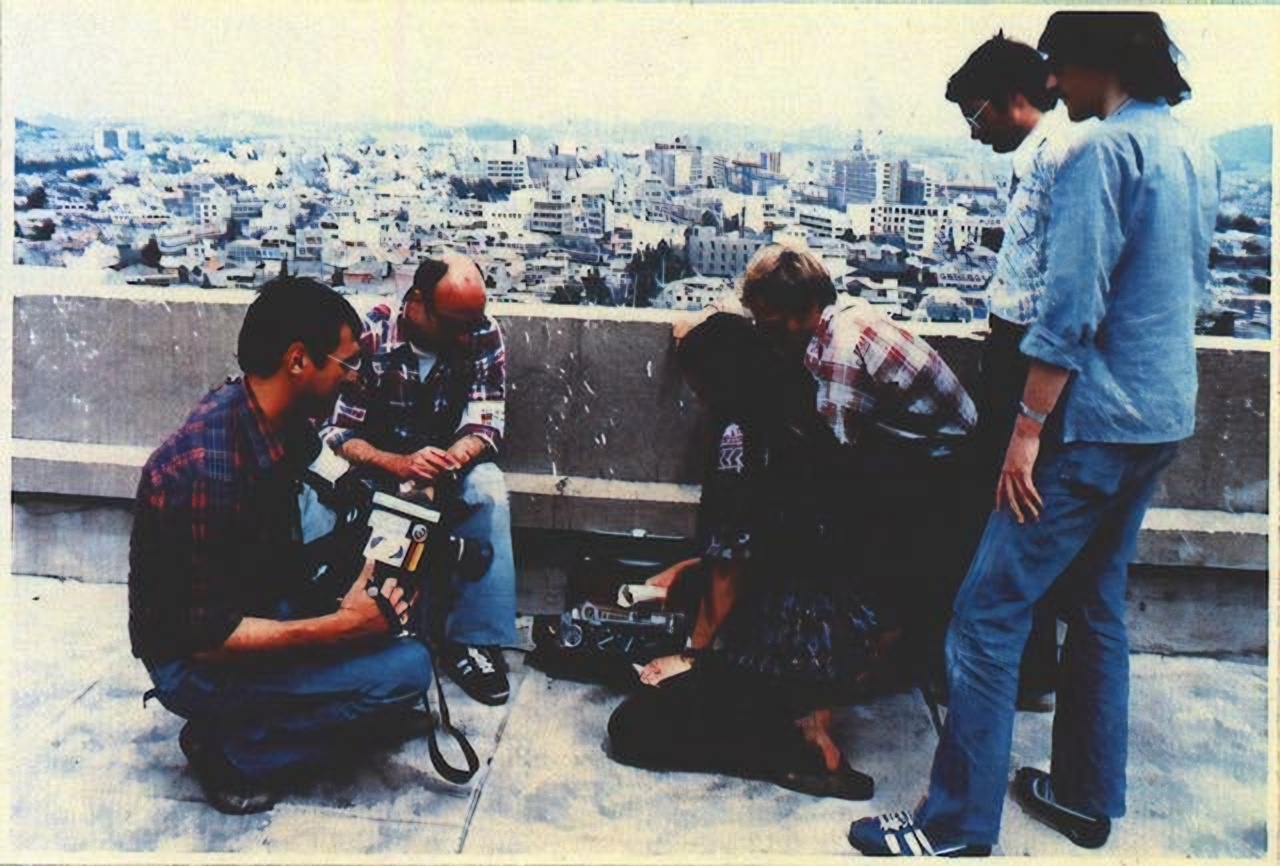
From left, German journalist Jurgen Hinzpeter and his assistant Henning Rumohr, and Peace Corps Volunteers Judi Chamberlin, Tim Warnberg, Paul Courtright and David Dolinger / Courtesy of Paul Courtright
Paul Courtright is back in Korea, and although he has revisited the country many times since his first time here as a Peace Corps Volunteer 45 years ago, there have been some significant developments since the last time he was here in October 2024.
A couple months after that visit, President Yoon Suk Yeol declared martial law.
“My first reaction to hearing about Yoon’s martial law declaration was of shock,” Courtright told The Korea Times. “Was this going to be a reenactment of 1980?”
Courtright is no stranger to such crises, as he received more than his fair share of experience while living in South Jeolla Province from 1979 to 1981.
In his first year, the strongman leader of the country, Park Chung-hee, was assassinated on Oct. 26, 1979. A short time after, on Dec. 12, Maj. Gen. Chun Doo-hwan seized control of the military in a violent coup and spent the next few months amassing power.
Students protested across the nation, but it was in Gwangju, then the capital of South Jeolla Province, where the situation became especially violent on May 18, 1980.
Courtright arrived by bus in Gwangju the following day, dispatched to help transfer two patients to a hospital in Suncheon. He said that shortly after he arrived, he witnessed two soldiers attack a young man, beating him viciously.
After completing his duties, Courtright returned to Gwangju the following day. He stayed there until May 25, when he hiked out over the mountains to get past the military forces besieging the city.
He hoped to reach the U.S. Embassy to tell them what was really happening in Gwangju, but no one at the embassy was willing to listen.
The events in the city later became known as the Gwangju Uprising. Chun’s forces ended up killing hundreds of citizens, and the truth behind the incident remained buried for decades after.
Paul Courtright in April 2016 / Courtesy of Paul Courtright
Courtright stayed in Korea until 1982, but the memories of what he witnessed never left him.
The cover of Paul Courtright’s book “Witnessing Gwangju” / Courtesy of Paul Courtright
“After leaving Korea,” he said, “I rarely spoke about Gwangju — when I did, I choked up and often started to cry.”
He also wrote to his representatives in government, but said there was “no meaningful response.”
“I felt that there was nothing I could do to help,” he said.
By the time Courtright wrote about his experiences in the 2020 book “Witnessing Gwangju,” Korea seemed like it had become an advanced democracy, and Gwangju was treated like a historical event in the nation’s past.
That illusion was shattered on the night of Dec. 3, 2024, when Yoon declared martial law. Yoon argued it was a necessary move to break legislative deadlock and suppress what he characterized as destabilizing opposition activity.
Unlike in 1980, this time it didn’t work. Thousands of citizens gathered outside the National Assembly, confronting the troops and creating the conditions for lawmakers to enter and vote down the decree. Yoon was later impeached and is now imprisoned.
“I was incredibly proud of the citizen’s actions, and it reminded me of the resilience that I witnessed in Gwangju in 1980,” Courtright said.
A woman holds a light during a rally in front of the National Assembly, Dec. 14, 2024, following then President Yoon Suk Yeol’s Dec. 3 martial law declaration. Courtesy of Bereket Alemayehu
Courtright will give a lecture for Royal Asiatic Society (RAS) Korea, sharing his perspectives on 1980 and 2024, drawing out lessons from both events and looking at the factors that resulted in different outcomes.
He also said he will relate these events to the current American political context.
“I hope to get the participants engaged in a discussion of what America — and other countries sliding toward autocracy — can learn from these two events in Korean history,” he said.
The lecture will be held May 12 at 7:20 p.m., in the basement of the Seoul Public Activities Center near Exit 8 of Samgakji Station on Seoul Metro lines 4 and 6. Entry costs 10,000 won, or 5,000 won for students of all ages with valid student ID, and is free for RAS Korea members. Visit raskb.com for more information.
PakarPBN
A Private Blog Network (PBN) is a collection of websites that are controlled by a single individual or organization and used primarily to build backlinks to a “money site” in order to influence its ranking in search engines such as Google. The core idea behind a PBN is based on the importance of backlinks in Google’s ranking algorithm. Since Google views backlinks as signals of authority and trust, some website owners attempt to artificially create these signals through a controlled network of sites.
In a typical PBN setup, the owner acquires expired or aged domains that already have existing authority, backlinks, and history. These domains are rebuilt with new content and hosted separately, often using different IP addresses, hosting providers, themes, and ownership details to make them appear unrelated. Within the content published on these sites, links are strategically placed that point to the main website the owner wants to rank higher. By doing this, the owner attempts to pass link equity (also known as “link juice”) from the PBN sites to the target website.
The purpose of a PBN is to give the impression that the target website is naturally earning links from multiple independent sources. If done effectively, this can temporarily improve keyword rankings, increase organic visibility, and drive more traffic from search results.