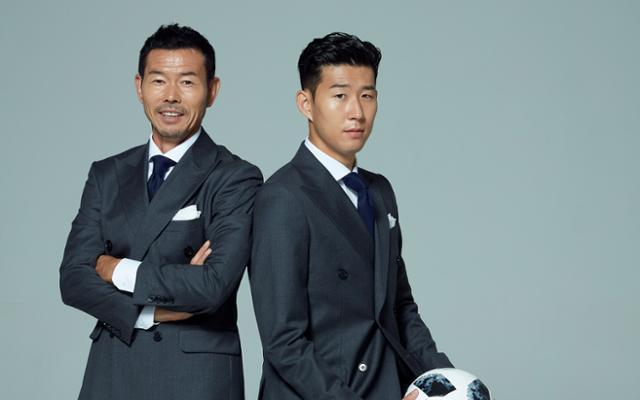

Korea’s football legend Son Heung-min, right, a forward for English Premier Leagueclub Tottenham Hospur, poses with his father Son Woong-jung in this photo released by Suo Books.
Nation advised to adapt to social change
The fathers of two Korean stars received seemingly unwanted attention last week following media reports about their alleged involvement in illicit activities. One was Son Woong-jung, the father of Korea’s world-class footballer Son Heung-min, and the other, was TV show host Park Soo-hong’s father whose name was not made public to protect his privacy.
Son Sr., along with two coaches at his football academy in Chuncheon, Gangwon Province have been charged with child abuse. Allegedly, they inflicted corporal punishment on some of their players. And a parent of one of the victims sued them. They are under investigation.
Park’s father returned to the spotlight following Thursday’s Constitutional Court ruling on a clause in the Criminal Law concerning fraud and embezzlement, which stipulates no punishment without a complaint filed against family members. In 2021, Park sued his older brother for secretly taking his money (embezzlement). During the trial, Park’s father claimed responsibility for overseeing his celebrity son’s financial affairs instead of his troubled older son, attempting to defend him. However, under current Criminal Law, even if his testimony was accepted, Park’s father would not face punishment.
On Thursday, the Constitutional Court ruled against the clause in the Criminal Law and directed the National Assembly to revise the law by 2025.If the revision is enacted, family members who commit fraud or embezzlement against other family members will be subject to prosecution.
The two cases — though distinct — share a common theme: celebrities are grappling with controversy involving their family members. This time, fathers created the problems. However, in future cases, it could involve siblings or mothers, potentially tarnishing the image of their celebrity family members.
However, this individual risk pales in comparison to the broader and profound implications for Korean society as a whole. Individuals, as well as the government and other organizations, that fail to adapt to changes, may face serious consequences.
In the past, risks related to family ties might have been justified or dismissed as insignificant.
Corporal punishment has historically been accepted as a part of Korea’s educational practices. Physical discipline at home and in schools was seen as a necessary measure for educating children, and thus, it was often justified. However, tolerance of corporal punishment has started to diminish as shocking crimes against children have shaken the nation, prompting calls for abusive adults to be held accountable.
Son’s father, 62, is from the older generation who grew up when corporal punishment was prevalent. Like some members of the older generation, he may have thought that he was simply educating the young athlete.
But if he did, he made a mistake.
Korea has changed a lot and physical punishment is no longer acceptable. Few parents will sit back and do nothing when their children come home with bruises on their bodies as a result of corporal punishment.
The top court’s ruling to revise the Criminal Law clause requiring a complaint for a trial is another striking example of how Korean society has changed.
In the past, there were instances where families relied on female siblings to forego their education and take up manufacturing jobs to support their brothers’ university education. These sacrifices were often praised socially. However, despite this recognition, the uneducated or undereducated siblings often faced difficult lives, while their college-educated brothers enjoyed security in white-collar jobs, thanks to their siblings’ sacrifices. During those times, the eldest sons inherited all family fortunes from their fathers, and other siblings accepted this arrangement without complaint.
However, today’s Korea has undergone significant changes. Forcing certain family members to sacrifice themselves for the well-being of other siblings in the name of family is no longer acceptable. The traditional prioritization of the eldest son has waned as awareness of gender equality has grown, with more girls now outperforming their male counterparts in various aspects of life.
As Korean society has shifted from extended to nuclear families, family bonds have weakened. This new era demands a fresh perspective, compelling individuals and organizations alike to choose between adapting to survive or facing stagnation and decline.
The lesson from these two fathers for Korea and Koreans boils down to the phrase: adapt when necessary.
Berita Korea Terbaru
berita terbaru artis korea
berita terbaru artis korea, berita terbaru korea, berita korea terbaru, berita artis korea terbaru, berita artis korea terbaru hari ini, berita selebriti korea terbaru, berita artis korea selatan terbaru, berita terbaru artis korea hari ini, berita terbaru korea utara vs amerika, berita terbaru konflik korea, berita terbaru artis korea selatan, berita artis terbaru korea, berita terbaru korea selatan, berita terbaru korea hari ini, berita terbaru hiburan korea
#Fathers #misdeeds #Korea #Times